
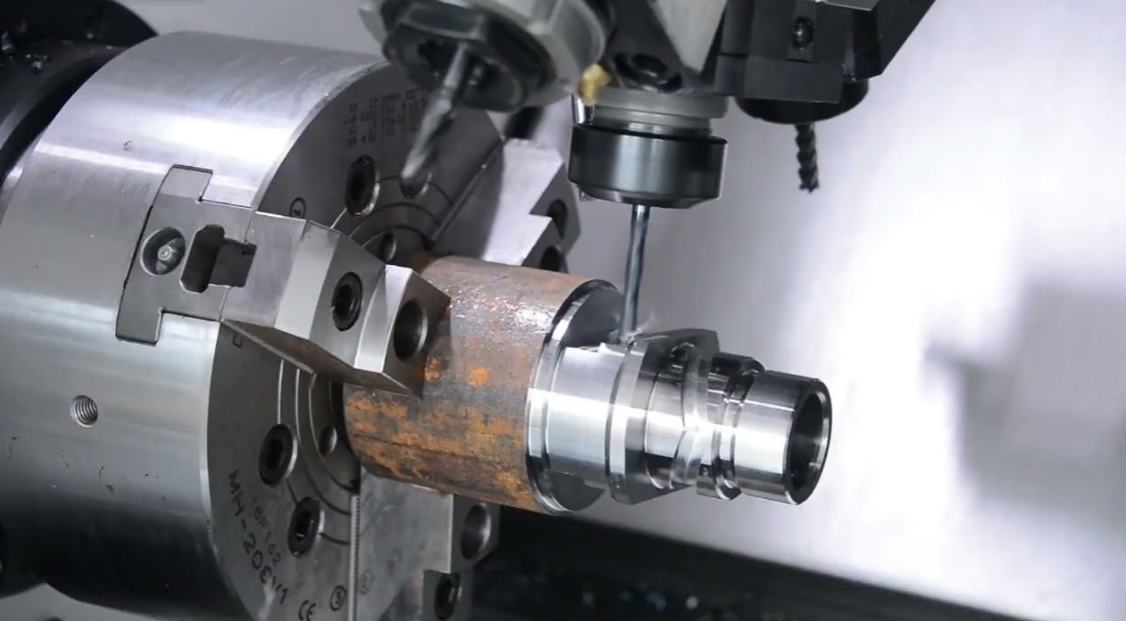
Turn-mill compound machining (also known as mill-turn or multi-tasking machining) is an advanced CNC manufacturing process that integrates turning and milling operations into a single machine tool.
1.Turning: The workpiece rotates while a stationary cutting tool removes material (ideal for cylindrical shapes).
2.Milling: The cutting tool rotates while the workpiece is held stationary or indexed (ideal for flats, slots, holes, and complex contours).
In turn-mill machines, these are combined using live tooling (rotating tools in the turret) and multi-axis control (often including C-axis for workpiece rotation and B-axis for tool tilting), allowing complete or near-complete machining in one setup.
This is distinct from simply adding live tools to a lathe; advanced turn-mill centers (e.g., with Y-axis, sub-spindle, or B-axis milling head) enable full 5-axis simultaneous machining.
How the Turn-Mill Process Works
1.Setup: The raw material (bar stock or billet) is clamped in the main spindle chuck.
2.Turning Operations: The spindle rotates the workpiece at high speed; fixed tools perform external/internal turning, facing, threading, grooving, etc.
3.Milling/Drilling Operations: The spindle indexes (C-axis) or stops; live tools in the turret rotate to mill features like flats, pockets, cross-holes, or contours. Advanced machines synchronize rotations for complex interpolation (e.g., helical grooves).
4.Optional Transfer: On twin-spindle machines, the part transfers to a sub-spindle for machining the opposite side without re-clamping.
5.Finishing & Inspection: Roughing → semi-finishing → finishing passes; many machines support in-process probing for accuracy.
The CNC controller coordinates axes (X, Z, Y, B, C) and tool paths for seamless transitions.
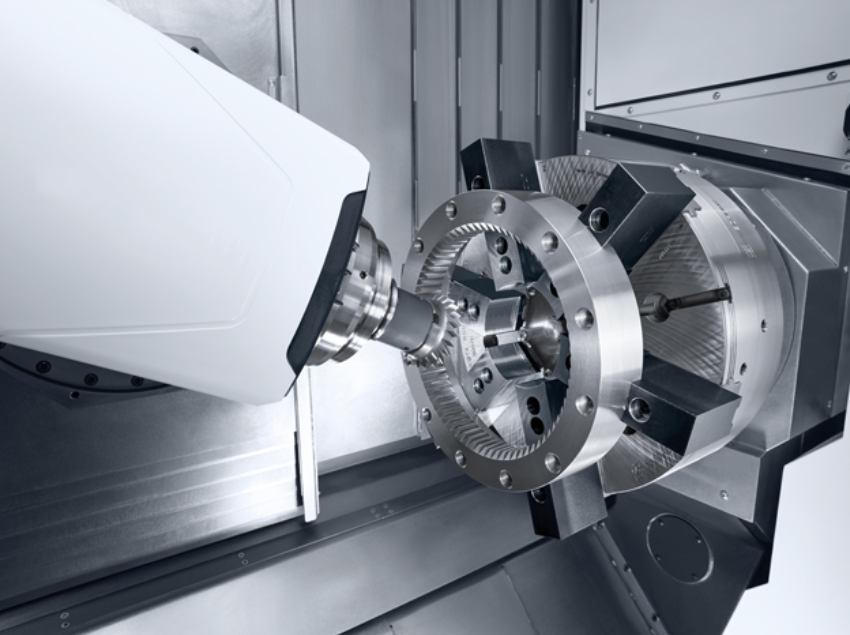
Advantages
1.Single Setup: Reduces handling, setup time, and positional errors → higher precision and repeatability.
2.Efficiency: Shortens production cycles (often 50-70% faster for complex parts); fewer machines/operators needed.
3.Complex Geometries: Ideal for parts with both rotational (cylinders) and prismatic features (slots, holes).
4.Cost Savings: Lower fixture requirements, reduced scrap, and energy use.
5.Quality: Minimizes cumulative tolerances; supports online measurement.
Applications & Example Workpieces
Common in aerospace (turbine blades, impellers), automotive (crankshafts, gears), medical (implants, instruments), and precision engineering.