Choosing the right plastic prototyping process is a balance between speed, cost, and how closely you need the part to mimic the final product. If you pick a method that's too high-fidelity early on, you waste money; if you pick one that's too flimsy for testing, you waste time.
Here is a breakdown to help you navigate the options.
1. Define Your Prototype Stage
Before looking at machines, ask yourself what the prototype needs to do.
Proof of Concept: Does it just need to show the shape? (Low fidelity, cheap).
Functional Prototype: Does it need to snap together, hold weight, or resist heat? (Medium fidelity).
Pre-production: Does it need to look and feel exactly like the shelf-ready product? (High fidelity).
2. Compare Common Manufacturing Processes
3D Printing (Additive Manufacturing)
Best for rapid iterations and complex geometries that are impossible to machine.
FDM (Filament): Cheapest; good for basic shapes and "fit" tests.
SLA (Resin): High detail and smooth surface finish; great for visual models.
SLS (Powder): Tough, functional nylon parts; no support structures needed.
CNC Machining (Subtractive)
Best for structural integrity and material "realness."
Pros: Uses actual production-grade plastics (like PEEK, Acetal, or Nylon). Extremely precise.
Cons: Expensive for complex internal shapes; more waste material.
Vacuum Casting (Urethane Casting)
The "bridge" between prototyping and production.
How it works: A 3D-printed master is used to create a silicone mold, which is then filled with resin.
Pros: Excellent surface finish; can mimic over-molding and different shore hardness (rubbery to rigid).
Rapid Tooling (Prototypal Injection Molding)
Best for testing the actual manufacturing process.
Pros: Uses aluminum molds instead of steel to save cost. Best for runs of 100+ parts.
Cons: High upfront cost compared to other prototype methods.
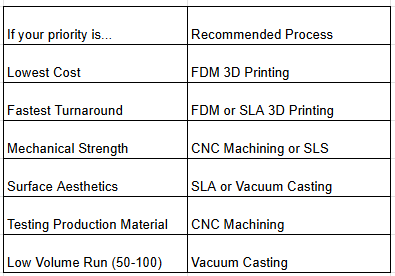
3. Decision Matrix: Which one to pick?