
How to Choose the Right Casting Method ?
Choosing the right casting method depends on your project's current stage, the material you need, and how many parts you want to make. Companies like Shenzhen Alu Rapid Prototype often offer a mix of these services because no single method fits every scenario.
Here is a guide to help you decide based on three "golden rules": Volume, Material, and Purpose.
1.The Decision Matrix: Quick Reference
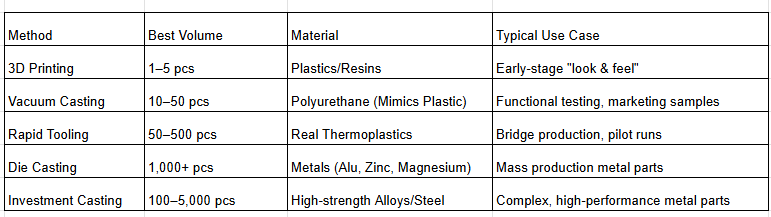
2. Choosing by Your Goals
1."I need it fast and cheap for a few tests."
Choice: 3D Printing (SLA/FDM)
Why: No molds required. You can have a part in 24 hours. Great for geometric validation but usually lacks the strength or finish of a "real" part.
2."I need 20 parts that look and feel like a real product."
Choice: Vacuum Casting (Silicone)
Why: This is the specialty of firms like Alu Rapid. You get high-fidelity parts with specific colors and textures without the $10,000+ cost of a steel mold.
Constraint: These parts are made of resins, not real production thermoplastics like ABS or PC (though they mimic them closely).
3."I need to test the actual material properties (Metal)."
Choice: CNC Machining or Investment Casting
Why: If your final part must be metal, CNC is best for low volumes. If the geometry is too complex for a drill bit, Investment Casting (using 3D printed wax patterns) allows you to get a high-strength metal part without industrial die-casting tools.
4."I'm ready for market and need 5,000 pieces."
Choice: Injection Molding (for plastic) or Die Casting (for metal).
Why: High upfront cost for the mold, but the "price per part" drops to pennies.
3. Critical Technical Factors
Before you choose, ask your manufacturer about these three "deal-breakers":
Tolerances: Does the part need to be accurate to ±0.05 mm? If so, CNC or InjectionMolding is better than Vacuum Casting.
Surface Finish: Do you need a "Clear" part or a specific "Mold-Tech" texture? Vacuumcasting is excellent for replicating surface textures from a master.
Draft Angles: Some methods (like Die Casting and Injection Molding) require the part tobe slightly tapered (angled) so it can slide out of the mold. Vacuum casting with flexiblesilicone molds is more forgiving and can often handle "undercuts" that other methodscan't.