Prototype plastic shaping refers to the various manufacturing techniques used to create preliminary, physical models of a plastic part before it goes into mass production.In the context of Shenzhen Alu Rapid Prototype Precision Co., Ltd., this isn't just one process but a toolkit of different "shaping" methods used to validate a design's look, feel, and function.
Common Methods of Plastic Shaping
Depending on whether you need a part that just looks right or one that works under stress, different shaping methods are used:
1. CNC Machining (Subtractive)
As discussed, this involves "carving" the part out of a solid block of plastic (like ABS, Nylon, or PC).
Best for: Functional testing where material strength is critical.
Alu Rapid Edge: They use high-speed CNC centers to achieve tight tolerances that mimic final production parts.
2. Vacuum Casting (Urethane Casting)
This is a two-step "shaping" process. First, a master pattern is made (usually via 3D printing). Then, a silicone mold is created around that pattern to cast multiple plastic copies.
Best for: Small batches (10–50 parts) and achieving high-quality surface finishes or transparency.
Why use it: It bridges the gap between a single prototype and a full production run.
3. 3D Printing (Additive)
This builds the shape layer-by-layer from a digital file. Methods include SLA (resin) for smooth surfaces and SLS (powder) for durable, moving parts.
Best for: Highly complex geometries that are impossible to machine or mold.
4. Rapid Injection Molding
This uses "soft" aluminum molds (instead of hard steel) to shape plastic.
Best for: Testing the actual material and "moldability" of a design before spending tens of thousands of dollars on permanent factory tooling.
Why "Shaping" Prototypes Matters
At firms like Shenzhen Alu Rapid, these processes are used to solve three main goals:
1.Form Study: Does the part look right? Does it fit in the hand (ergonomics)?
2.Fit Testing: Does the plastic part snap into the rest of the assembly correctly?
3.Functional Testing: Can the plastic withstand the heat or friction it will face in the real world?
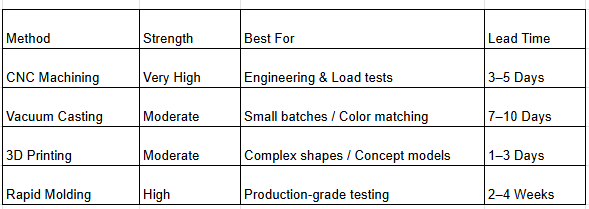
Summary Table: Choosing a Shaping Method