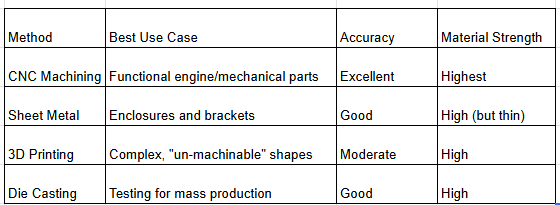
When you need a metal prototype, the "best" method usually depends on your material choice and how the part will be used. Shenzhen Alu Rapid Prototype Precision Co., Ltd. utilizes several industrial-grade techniques to transform metal alloys into functional prototypes.
Here are the primary methods used for metal prototyping:
1. CNC Machining (Milling & Turning)
This is the "gold standard" for metal prototyping because it uses the actual productionmaterial (e.g., a solid block of 6061 Aluminum or 304 Stainless Steel).
How it works: A computer-controlled cutting tool carves the part out of a solid block.
Best for: Parts that require high strength, tight tolerances (0.O1mm), and a "production-grade" surface finish.
Alu Rapid Specialization: They utilize 3-axis, 4-axis, and 5-axis CNC machines, whichallow for complex shapes that simpler machines can't reach.
2. Sheet Metal Fabrication
If your part is a thin-walled enclosure, bracket, or panel, it is "shaped" rather than "carved."
Processes include: Laser cutting the flat shape, then using a press brake to bend it into the final 3D form.
Best for: Computer cases, medical device housings, and automotive brackets.
3. Metal 3D Printing (DMLS / SLM)
Technically known as Direct Metal Laser Sintering, this is an additive process.
How it works: A high-power laser melts layers of fine metal powder (Titanium, Aluminum, or Steel) to build a part from the ground up.
Best for: Extremely complex internal geometries or organic shapes that a CNC drill bit simply cannot reach.
4. Rapid Die Casting
While traditional die casting is for mass production, companies like Alu Rapid offer "rapid" versions for prototypes.
How it works: They create simplified aluminum or "soft steel" molds to inject molten metal.
Best for: Testing the material properties and weight of a part that will eventually be mass-produced via die casting.
5. Wire EDM (Electrical Discharge Machining)
How it works: Uses a thin, electrically charged wire to "slice" through hard metals with extreme precision.
Best for: Cutting very thick metal or creating delicate slots and shapes in extremely hard materials like hardened tool steel.
Comparison Summary