Rapid prototyping is a group of techniques used to quickly fabricate a scale model of a physical part or assembly using three-dimensional computer-aided design (CAD) data. Think of it as the "drafting" phase of manufacturing—it allows engineers and designers to hold their ideas in their hands without the massive overhead of traditional factory tooling.
Here is a breakdown of its primary uses:
1. Design Validation and Iteration
This is the most common use. Before committing to expensive mass production, designers need to see if their concept actually works in the real world.
Proof of Concept: Does the idea work?
Ergonomics: Does the handle fit a human hand? Is the button reachable?
Visual Feedback: It’s much easier to spot a "clunky" design on a desk than on a 2D screen.
2. Functional Testing
Rapid prototyping allows for "fit and function" testing. If you are designing a complex gearbox, you can print the gears to ensure they mesh correctly before machining them out of high-grade steel.
Material Testing: Modern 3D printing can use resins or metals that mimic the properties of the final production material.
Assembly Check: Ensuring that Part A actually fits into Part B without needing a hammer.
3. Tooling and Manufacturing Support
Sometimes the prototype isn't the end product, but a "means to an end."
Bridge Tooling: Using 3D printed molds to create a small run of parts while waiting for permanent steel molds to be manufactured.
Jigs and Fixtures: Creating custom holders or guides to help workers on an assembly line.
4. Communication and Stakeholder Buy-in
It is significantly easier to get a budget approved or a client to say "yes" when they can touch the product. It bridges the gap between technical drawings and a finished vision.
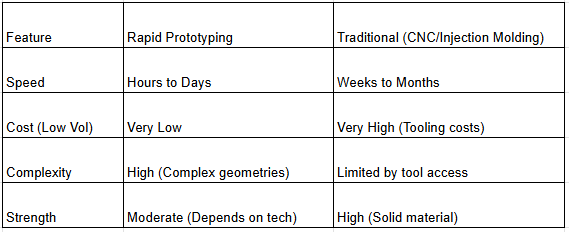
Comparison: Rapid Prototyping vs. Traditional Manufacturing