
Is die cast aluminum strong?
The short answer is yes, die-cast aluminum is very strong, especially when you consider its weight. However, "strength" in engineering is a bit of a loaded term. It depends on whether you are looking for raw hardness, the ability to bend without breaking, or how much weight it can support.
Here is a breakdown of how die-cast aluminum holds up in the real world.
Strength-to-Weight Ratio
Aluminum’s "superpower" isn't its absolute strength, but its strength-to-weight ratio. While steel is technically stronger in terms of pure tensile strength, aluminum is about one-third the weight.
This means that for industries like aerospace or automotive, you can use a thicker, rigid piece of aluminum that is still lighter than a thinner piece of steel, providing excellent structural integrity without the bulk.
Key Mechanical Properties
To understand if it’s "strong" enough for your needs, look at these three factors:
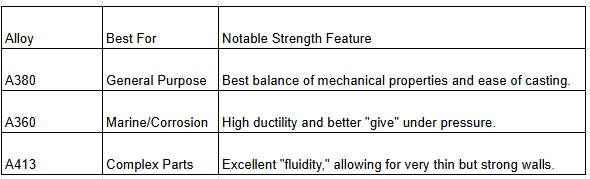
Tensile Strength: Most common die-casting alloys (like A380) have a tensile strength of around 310 MPa (45,000 psi). For comparison, that’s stronger than many plastics and cast irons, though lower than high-strength steel.
Dimensional Stability: Die-cast aluminum is incredibly rigid. Once it’s cast, it holds its shape under significant heat and stress, which is why it’s used for engine blocks and heat sinks.
Hardness: Because the molten metal is injected into the mold under high pressure, the resulting grain structure is very dense. This makes the surface quite hard and resistant to wear.
The Trade-off: Brittleness
If there is a "weakness" to die-cast aluminum, it’s ductility.
It doesn't like to bend: Unlike wrought aluminum (the kind used in soda cans or car frames), die-cast aluminum is brittle.
The "Snap" Factor: If you put enough pressure on a die-cast part, it won't deform or "give" very much before it simply snaps. This makes it great for rigid housings, but less ideal for parts that need to absorb impact by bending.
Common Alloys and Their Strengths
Summary
Die-cast aluminum is plenty strong for structural housings, engine components, and consumer electronics. It offers a "pro-level" mix of high rigidity, heat resistance, and low weight, provided your design doesn't require the metal to flex or bend significantly
.