
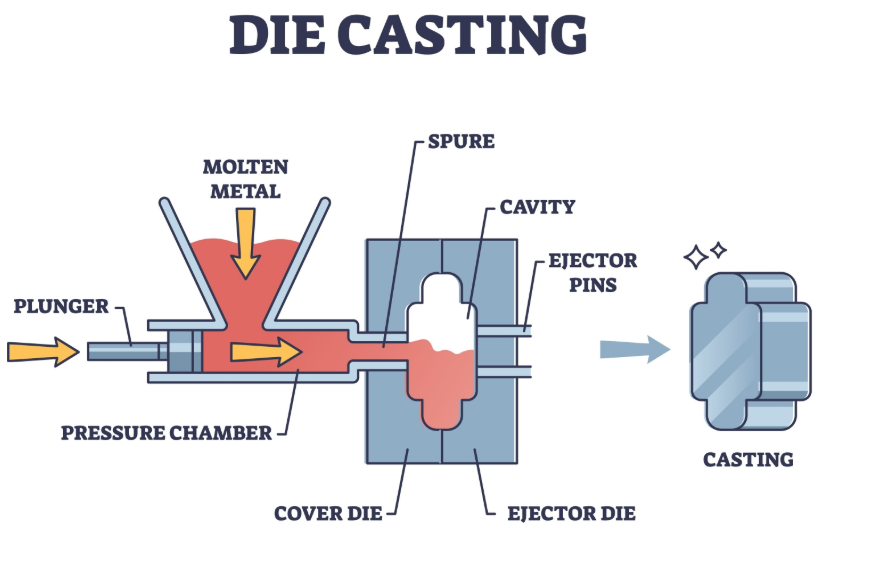
Aluminum die casting is a manufacturing process that produces highly detailed metal parts by forcing molten aluminum into a reusable steel mold, known as a die. Think of it like a high-tech, industrial version of a waffle iron—but with molten metal and incredible pressure.
Here is the step-by-step breakdown of the Cold Chamber die casting process, which is the standard method for aluminum.
The 4-Step Process
1.Preparation and Lubrication
The two halves of the steel die are cleaned and sprayed with a lubricant. This helps regulate the temperature of the metal and ensures the finished part can be removed easily. The die halves are then clamped shut with massive hydraulic pressure.
2.Injection (The Shot)
Since aluminum has a high melting point, it is melted in a separate furnace. A precise amount of molten aluminum is "ladled" into a cylindrical shot chamber. A hydraulic piston (plunger) then forces the metal into the die cavity at extremely high pressure.
3.Cooling and Solidification
The metal cools rapidly inside the steel die. Because the die is water-cooled, the aluminum solidifies almost instantly, taking the exact shape of the mold.
4.Ejection and Trimming
The die opens, and ejector pins push the solid aluminum part out. At this stage, the part usually has "flash" (excess metal that leaked between the mold halves) and the "sprue" (the hardened metal from the entry channel), which are trimmed off in a separate press.
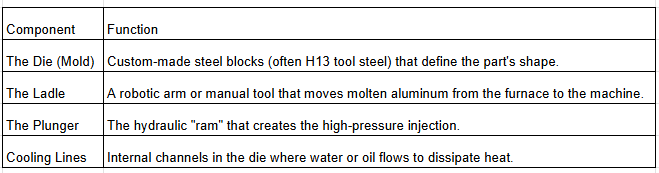
Key Components of the Machinery
Why Use Die Casting?
1.Complex Geometry: It can produce parts with thin walls and intricate details that would be impossible with other methods.
2.Speed: It is incredibly fast. High-volume machines can produce hundreds or even thousands of parts per day.
3.Dimensional Accuracy: The parts are very consistent. If you make 10,000 units, the first and the last will be nearly identical.
4.Strength: The high pressure used during injection creates a dense, fine-grained metal structure that is very strong.
Challenges to Keep in Mind
As we discussed regarding powder coating, the main enemy of die casting is porosity. Because the metal is injected so fast, air can get trapped inside. Engineers use "vents" and "overflows" in the mold design to give that air a