
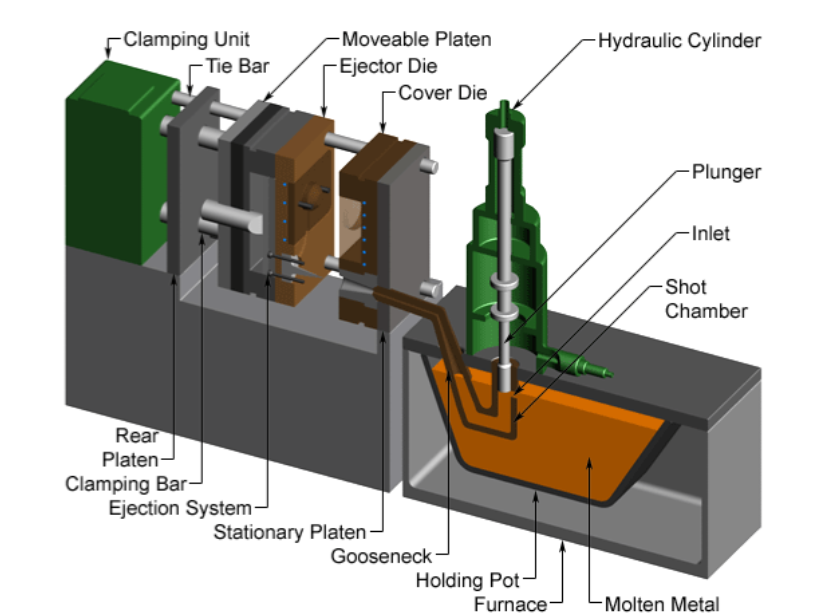
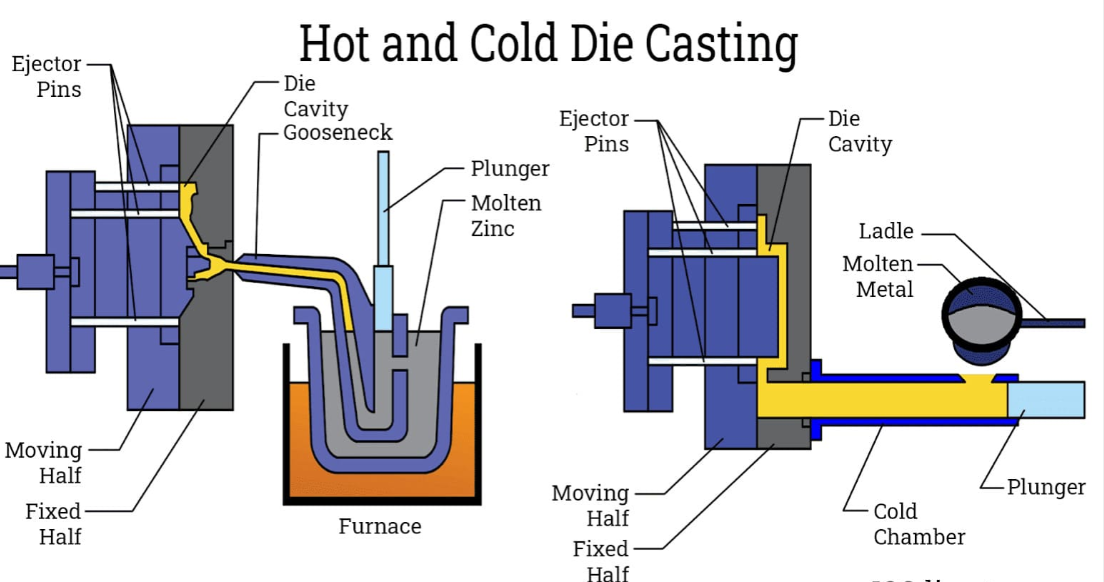
Aluminum die casting is a high-pressure manufacturing process used to produce precise, complex metal parts in large volumes with excellent surface finish and dimensional accuracy. It's especially popular for aluminum alloys due to their low melting point, good fluidity, lightweight properties, and strength.The most common method for aluminum is high-pressure die casting (HPDC) using a cold chamber machine — because aluminum's high melting temperature (~660°C / 1220°F) would damage the injection system in a hot chamber setup (which is more typical for lower-melting metals like zinc).
Step-by-Step: How Aluminum Die Casting Works (Cold Chamber High-Pressure Process)
1.Die Preparation
The steel die (mold) — made of two or more sections (fixed and movable halves) — is cleaned, sprayed with a release agent/lubricant to prevent sticking and aid ejection, and often preheated to reduce thermal shock and improve metal flow.
2..Melting the Aluminum
Aluminum ingots or scrap are melted in a separate furnace (e.g., induction furnace) to around 660–750°C (1220–1380°F). The molten aluminum is refined (e.g., degassed with argon to remove impurities and gases) for better quality castings.
3.Transfer to the Shot Chamber
A measured amount of molten aluminum (the "shot") is ladled or automatically poured from the holding furnace into the cold shot chamber (a cylindrical sleeve) of the die casting machine. This keeps the injection plunger from being constantly exposed to high heat.
4.Die Clamping
The two die halves are hydraulically clamped together under very high force (hundreds to thousands of tons, depending on part size) to withstand the injection pressure without separating.
5.High-Pressure Injection
A hydraulic plunger rapidly forces the molten aluminum through narrow channels (runners and gates) into the die cavity at pressures of 7–207 MPa (1,000–30,000 psi). This fills even thin sections and complex geometries quickly (often in milliseconds).
6.Solidification
The metal cools and solidifies very rapidly due to the massive heat transfer to the steel die (often water-cooled). This happens in seconds, producing a fine-grained structure and good mechanical properties.
7.Die Opening and Ejection
Once solidified, the die halves separate. Ejector pins push the casting (plus any attached runner/gate material) out of the cavity.
8.Trimming and Secondary Operations
Excess material (flash, gates, runners) is trimmed off using trimming dies or CNC. Additional steps may include shot blasting, heat treatment, machining, surface finishing (e.g., powder coating — as we discussed earlier), or inspection.
Key Advantages for Aluminum Die Casting
1.High production rates (thousands of parts per day possible)
2.Excellent dimensional accuracy and repeatability
3.Thin walls and complex shapes achievable
4.Good surface finish right from the die
5.Lightweight, corrosion-resistant parts
Common applications include automotive components (engine blocks, transmission cases), electronics housings, lighting fixtures, and consumer products.As a rapid prototyping and die casting specialist (like Shenzhen Alu Rapid Prototype), this process is ideal for scaling from prototypes to mass production with aluminum parts.