
Aluminum die casting is essentially a "high-entry, low-exit" financial commitment. It is very expensive to start but becomes one of the cheapest ways to manufacture once you reach high volumes.
As of 2026, here is the realistic breakdown of what you can expect to pay.
1. The "Entry Fee": Tooling Costs
The most significant expense is the die (the mold). These are carved from high-grade tool steel to withstand the immense pressure of molten aluminum.
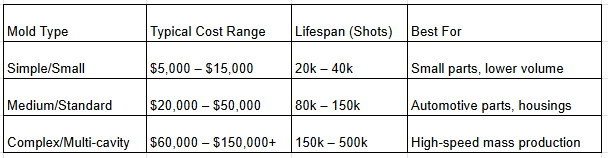
Pro Tip: If your part has "undercuts" (features that prevent it from sliding straight out of the mold), you’ll need moving slides, which can easily add $5,000–$10,000 per slide to your tooling bill.
2. The "Running Fee": Unit Price
Once the mold is paid for, the price per part is surprisingly low. For a standard aluminum part (like a motor housing or a bracket), the cost typically breaks down as follows:
1.Material Cost: Aluminum alloys (like A380) currently hover around $3.00 - $4.50 per kg.
2.Production Fee: This is the "machine time." Depending on the size of the machine(tonnage), this costs roughly $0.50 to $2.50 per "shot" (one cycle of the machine).
3.Total Per-Part Estimate:
Simple parts: $1.00 - $5.00 each.
Large/Complex parts: $10.00 - $40.00 each.
3. When is it "Worth It"? (The Break-Even Point)
Because of the high tooling cost, die casting is rarely the right choice for fewer than 1,000 to2,000 parts.
1.< 500 units: Use CNC Machining. It has $0 tooling cost.
2.500 - 2,000 units: Consider Sand Casting or 3D Metal Printing. Tooling is cheap($1,500), but the parts are expensive to finish.
3.> 2,000 units: Die Casting becomes the winner. The "savings" from the low unit priceeventually "pay back" the $30,000 you spent on the mold.
4. Hidden Cost Drivers
Don't forget these "extras" that can bloat your quote by 20-40%:
1.Secondary Machining: Die casting is precise, but if you need a perfectly flat mating surface or threaded holes, you’ll pay for CNC "post-processing."
2.Surface Finishing: Anodizing, powder coating, or chrome plating adds significant cost per part.
3.Scrap Rate: In 2026, energy and material volatility mean foundries often bake a 3-5% "defect buffer" into their pricing.