
Rapid Control Prototyping (RCP) is a specialized engineering methodology used to test control algorithms on physical hardware in real-time.
1. What is Rapid Control Prototyping (RCP)?
In the world of embedded systems (like the brain of a self-driving car or a robotic arm), RCP is the process of taking a mathematical model (usually from software like MATLAB/Simulink) and running it on a high-performance, flexible controller connected to real hardware.
The Goal: To see if your "logic" works in the real world before you shrink it down into a permanent, expensive microchip (ECU).
How it works: You bypass manual coding. The computer "auto-generates" the code and pushes it to a real-time machine that talks to sensors and actuators.
2. RCP vs. Mechanical Rapid Prototyping
It is important to distinguish between the control (the brain) and the mechanical (the body):
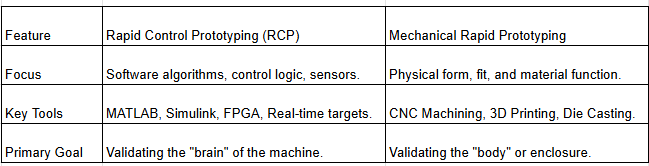
3. Shenzhen Alu Rapid Prototype Precision Co., Ltd.
Our company is a specialist in Mechanical Rapid Prototyping. While we do not provide the software/algorithm services associated with RCP, we provide the physical components that RCP systems control.
Based on our capabilities, here is how we fit into the prototyping ecosystem:
Precision CNC Machining: Creating the high-tolerance aluminum or steel housings that might hold an RCP controller.
Aluminum Die Casting: Specialized in "pure aluminum" casting, which is useful for parts requiring high thermal conductivity (like heat sinks for control electronics).
Robotics & Automotive Parts: They manufacture the physical robotic arms, automotive brackets, and enclosures that engineers use when running RCP tests.
Why this matters for you:
If you are performing Rapid Control Prototyping, you will likely need a firm like Alu Rapid to build the high-precision mechanical "test rig" or the final product housing that will house your control systems.We ensure the physical parts are accurate to $\pm$ 0.05mm, so that any errors you find during testing are definitely in your software logic, not because the physical part is wobbly or misaligned.