
CNC machining prototype (often called CNC prototype machining or prototype CNC machining) is a rapid prototyping method that uses computer numerical control (CNC) machines to create precise, functional prototypes or low-volume parts directly from a digital 3D model (usually a CAD file).It belongs to subtractive manufacturing: a solid block of material (metal like aluminum, steel, titanium, or plastic like ABS, POM, nylon) is progressively cut away using rotating tools until the desired shape is achieved.
Core Process of CNC Prototype Machining
1.Design — Engineer creates a detailed 3D CAD model.
2.CAM programming — The model is converted into machine instructions (G-code) that tell the CNC machine exactly how to move.
3.Setup — Raw material block is fixed in the machine; appropriate tools (end mills, drills, etc.) are loaded.
4.Machining — Common operations include:
CNC milling (most common for prototypes — creates complex shapes, pockets, holes, flat surfaces)
CNC turning/lathing (for cylindrical/rotational parts like shafts, bushings)
Multi-axis machining (3-axis, 4-axis, 5-axis) for more complex geometries
5.Post-processing — deburring, sanding, anodizing, polishing, bead blasting, etc., to reach the final surface finish.
6.Inspection — Using CMM, gauges, or scanners to verify dimensions and tolerances.
Typical tolerances: ±0.01–0.05 mm (very tight compared to most 3D printing technologies).
Key Advantages for Prototyping
1.Very high accuracy and repeatability
2.Excellent surface finish right off the machine (often Ra 0.8–1.6 μm)
3.Uses real production-grade materials (same as final parts) → truly functional testing possible
4.Fast turnaround — many service providers deliver parts in 3–10 days
5.No tooling/mold cost (unlike injection molding)
6.Handles complex geometries very well (especially with 5-axis machines)
7.Ideal for design validation, fit & function testing, pre-production verification
Typical Applications
1.Automotive / EV components
2.Aerospace parts
3.Medical device prototypes
4.Consumer electronics enclosures
5.Robotics & automation components
6.Custom machinery parts
Comparison Table: CNC Prototyping vs Common Alternatives
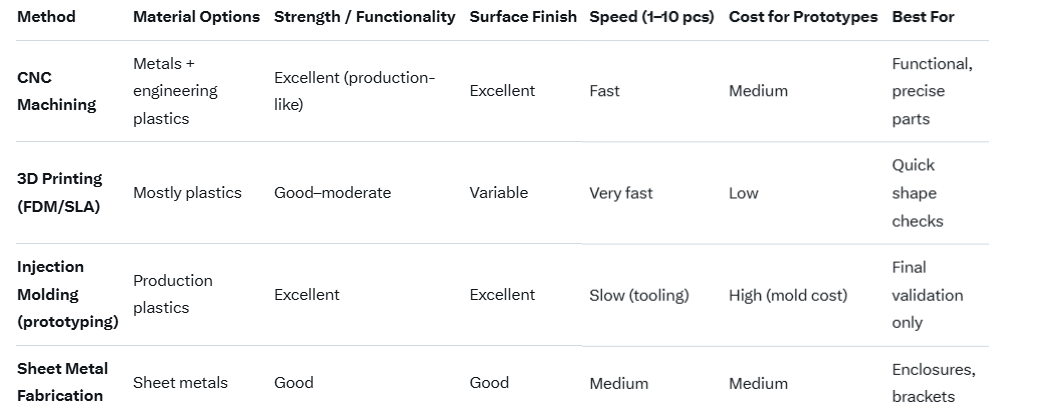
In short: If you need strong, accurate, production-material prototypes quickly (usually 1–200 pieces), CNC machining is still one of the most reliable and widely used rapid prototyping technologies in 2026.Many companies (including those in Shenzhen's vast manufacturing ecosystem) specialize exactly in this service — offering fast quotes, DFM feedback, and delivery in days.