Aluminum die casting is a high-pressure manufacturing process that transforms molten aluminum into complex, high-precision parts. Unlike some other metals, aluminum is almost exclusively cast using the Cold Chamber Process because its high melting point would damage the internal components of a standard hot-chamber machine.
Here is the step-by-step process used by professional manufacturers like Shenzhen Alu Rapid Prototype:
1. Preparation and Clamping
The process begins with a steel mold (called a die), which is divided into two halves: the stationary half and the movable half.
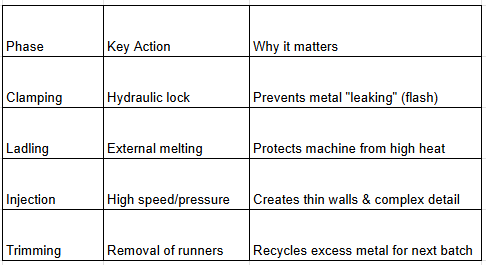
The machine applies massive hydraulic pressure to clamp these halves together, ensuring they stay sealed against the extreme pressure of the incoming metal.
A release agent (lubricant) is sprayed onto the die surfaces to control temperature and ensure the finished part doesn't stick.
2. Melting and Ladling (Cold Chamber)
Because aluminum melts at roughly 660°C (1,220°F), it is melted in a separate furnace outside the casting machine.
A robotic or manual ladle scoops the molten aluminum and pours it into a "shot sleeve" (an unheated cylindrical chamber).
This is why it's called "Cold Chamber"—the injection system isn't submerged in the molten metal.
3. High-Pressure Injection
A hydraulic piston (plunger) moves forward at incredible speeds, forcing the molten aluminum into the die cavity.
Pressure: The metal is injected at pressures ranging from 1,500 to 25,000 PSI.
Speed: The cavity is filled in a fraction of a second, ensuring the metal reaches every intricate detail of the mold before it begins to cool.
4. Cooling and Solidification
The metal cools rapidly inside the water-cooled steel die.
The machine maintains pressure during this stage to prevent porosity (tiny air bubbles) and ensure the part remains dense and structurally sound.
5. Ejection
Once the part is solid, the movable half of the die opens.
Ejector pins push the casting out of the mold. At this stage, the part still includes the "gate" and "runners"—the excess metal channels that allowed the aluminum to flow in.
6. Trimming and Finishing
The raw casting undergoes several post-processing steps:
Trimming: Excess material (flash) is cut off using a trimming die or saw.
Deburring: Sharp edges are removed via vibrating tumblers or manual grinding.
Surface Treatment: Depending on the requirement, the part may be sandblasted, anodized, or powder-coated for aesthetics and corrosion resistance.
Process Summary Table