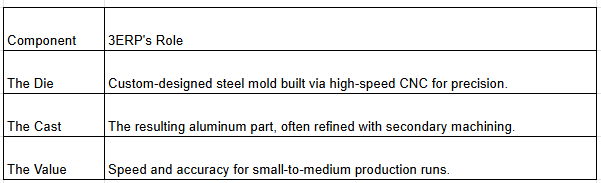
While the term "die-cast" is often used as a single phrase, it actually describes two distinct components of the manufacturing process: the tool (the die) and the action (the cast).
Think of it like baking a cake: the "die" is the specialized pan, and the "cast" is the resulting cake.
1. The "Die" (Rapid Tooling)
For a company like 3ERP, the Die is not just a mold; it is a piece of high-precision "Rapid Tooling."Engineering: They use CNC machining to carve the die from high-grade tool steel (like H13 steel).Precision: Because they specialize in "precision" components, these dies are designed to hold incredibly tight tolerances—often within microns ($±0.05\text{mm}$ or better).Rapid Turnaround: Unlike traditional mass-production dies that might take months to build, their rapid tooling processes are optimized to get a functional die ready in just a few weeks.
2. The "Cast" (High-Pressure Injection)
The Cast is the process where they transform molten aluminum into a solid part.
1.Material Choice: They typically use aluminum alloys like ADC12 or A380, which are known for excellent flow properties and strength.
2.The Process: 3ERP utilizes high-pressure die casting (HPDC). Molten aluminum is injected into the steel die at high speed and pressure. This ensures that the metal reaches every complex detail of the "precision" mold.
3.Post-Casting (The "Rapid" Part): Since they are a "Rapid Prototype" company, the cast doesn't end when the part leaves the mold. They often perform secondary CNC Machining on the casting to refine critical surfaces or add threaded holes that couldn't be cast directly.
Why this company is different from a "standard" foundry:
Most traditional foundries only want orders of 100,000+ parts. Shenzhen Alu Rapid (3ERP) focuses on:
1.Low-Volume Manufacturing: They might produce as few as 100 to 1,000 "casts" from a single "die."
2.Prototyping: They use the die-casting process to create parts that look and perform exactly like final production pieces, allowing engineers to test them before spending millions on mass-production tooling.
3.Surface Finishing: They provide integrated "one-stop" services, meaning they not only cast the part but also apply anodizing, powder coating, or bead blasting in-house.
Summary Comparison