
Can you injection mold soft plastic?
Yes, we absolutely can. In the world of precision manufacturing—especially with a partner like Shenzhen Alu Rapid Prototype Precision Co., Ltd. (3ERP)—this is a very common request.
When we talk about "soft plastic" in injection molding, we aren't usually talking about melting down a rubber band. Instead, we use a category of materials called TPE (Thermoplastic Elastomers) or TPU (Thermoplastic Polyurethane).
How "Softness" is Measured
In injection molding, softness is measured on the Shore Durometer scale.
Shore A: Used for flexible materials (like a pencil eraser or a rubber grip).
Shore D: Used for harder, semi-rigid materials (like a hard hat or a golf ball).
Precision molders can typically handle a range from 10A (very soft/gel-like) to 90A (tough/tire tread).
Common Soft Materials Used by 3ERP
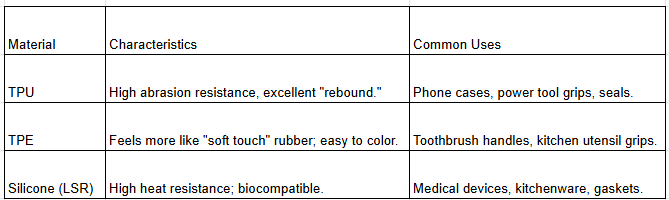
Two Ways to Mold Soft Plastic
Depending on your design, a prototype specialist like Shenzhen Alu Rapid will use one of two methods:
1. Single-Part Molding
The entire part is made of the soft material. This is common for gaskets, seals, or flexible tubing.
Challenge: Soft parts can be tricky to "eject" from the mold because they are floppy. The mold design (the Die) must be engineered specifically to pop the part out without tearing it.
2. Overmolding (The "Pro" Choice)
This is where 3ERP’s precision really shines. They first mold a "hard" plastic base (like ABS or Polycarbonate) and then mold the "soft" plastic (TPE/TPU) directly onto it.
Why do this? It creates a finished product with a rigid internal structure and a comfortable, non-slip "soft-touch" exterior.
Example: The handle of a high-end screwdriver or a ruggedized waterproof electronics housing.
Key Considerations for Your Project
Shrinkage: Soft plastics shrink much more than hard plastics as they cool. If you are aiming for "Precision" (as the name Shenzhen Alu Rapid implies), the mold must be slightly oversized to account for this.
Wall Thickness: If a soft part is too thin, it won't fill the mold properly; if it's too thick, it may develop "sink marks" (dents on the surface).
Bonding: Not all soft plastics "stick" to all hard plastics. For overmolding, the two materials must be chemically compatible.