
The short answer is: it depends on your production volume and the material you are molding. Heat treating is a double-edged sword. While it makes a mold incredibly durable, it also adds cost, time, and the risk of the steel warping during the process.
Here is a breakdown of when you should—and shouldn't—pull the trigger on heat treating.
1. The "Why": Benefits of Heat Treating
The primary goal of heat treating (usually to a hardness of 48–60+ HRC) is to transform the steel's molecular structure to make it "glass-hard."
Wear Resistance: Essential if you are using "filled" plastics (like those with glass fibers), which act like sandpaper and can erode soft steel.
Flash Prevention: Harder steel maintains crisp shut-off edges, preventing plastic from leaking out (flashing) over time.
Longevity: A heat-treated tool can often run for 1 million+ cycles, whereas a "soft" tool might degrade after 50,000 to 100,000.
2. When You Can Skip It (Pre-Hardened Steel)
Many molds are made from P20 or 718 steel. These are "pre-hardened" to roughly 30–36 HRC.
Prototyping: If you only need 1,000 to 10,000 parts, P20 is more than enough.
Large Parts: Heat treating very large blocks of steel is risky and expensive.
Tight Timelines: Since you don’t have to send the mold out to a furnace and then "clean up" the dimensions afterward, you save 1–2 weeks of lead time.
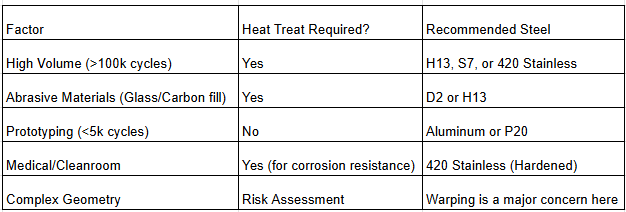
3. Decision Matrix
To help you decide, check where your project falls in this table:
4. The Critical Trade-off: Brittle vs. Tough
It’s a common misconception that "harder is always better." As steel becomes harder, it also becomes more brittle.
If your mold design has thin "standing ribs" or delicate cores, a fully hardened tool (like D2 steel) might actually snap under injection pressure, whereas a softer, tougher steel (like P20) would have flexed slightly and survived.
Summary Advice
If you are running unfilled resins (like PP or ABS) for a medium production run (under 50k units), you likely do not need to heat treat. You’ll save money and get your parts faster.
However, if your resin has "GF" (Glass Fiber) in the name, or if this tool needs to run for the next five years, heat treating is mandatory.