
Getting a plastic injection mold designed and made is a major milestone. Since we just discussed heat treating, it’s important to see how that fits into the broader timeline.
The process is generally divided into design, fabrication, and validation. Here is the roadmap for 2026:
Phase 1: Design & DFM (1–2 Weeks)
Before any steel is cut, you must "freeze" your part design.
DFM (Design for Manufacturability): Your mold maker will review your 3D model for "traps." They look for:
Draft Angles: Are the walls tapered (usually 1.5° to 2°) so the part can slide out?
Wall Thickness: Is it uniform? Thick spots cause "sink marks" (dents).
Gate Placement: Where the plastic enters the part (this leaves a small scar).
Mold Design: The engineer creates a 3D assembly of the mold itself, including the cooling lines, ejector pins, and the "parting line" (where the two halves meet).
Phase 2: Fabrication (4–8 Weeks)
This is the longest phase. The shop uses several high-tech methods:
CNC Machining: Carving the main shape out of a block of steel or luminum.
EDM (Electrical Discharge Machining): Using electricity to "burn" intricate details or sharp corners that a round drill bit can't reach.
Heat Treatment: If required (as we discussed), the steel is sent to a furnace now.
Polishing: The mold surfaces are smoothed to your desired finish (from a rough "matte" to a "high-gloss mirror").
Phase 3: Mold Trial (T1) & Validation (1 Week)
The mold is mounted on a machine for its first "shot" (called T1 samples).
Debugging: Expect the first parts to have minor issues like "flash" (extra plastic) or "short shots" (incomplete parts).
Tweaking: The mold maker adjusts the pressure, temperature, or physical steel to perfect the part.
Approval: Once you approve the samples, the mold is ready for mass production.
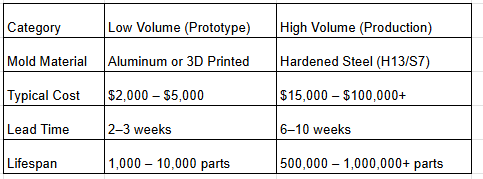
Estimated Costs (2026 Estimates)
Pro-Tip: The "Family Mold"
If you have multiple small parts (e.g., a top and bottom shell), you can often put them into one single mold base. This is called a Family Mold and can save you 30–50% on tooling costs compared to making two separate molds.