
Ventilation in injection molding facilities is a high-stakes balancing act. You aren't just managing comfortable temperatures; you're dealing with excessive heat gain from the machines, volatile organic compounds (VOCs) from melting plastics, and the need for particle control to ensure product quality.
Most facilities use a combination of these three systems:
1. General Dilution Ventilation (HVAC)
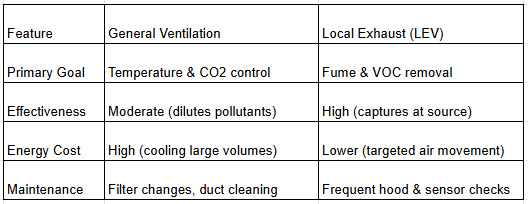
This is the "big picture" approach. Large rooftop units (RTUs) or industrial fans circulate massive volumes of air to lower the overall temperature and reduce the concentration of fumes.
Air Changes per Hour (ACH): Injection molding plants typically require much higher ACH rates than standard warehouses—often between 10 to 20 changes per hour—to combat the heat generated by the heater bands and hydraulic motors.
Negative Pressure: Often, the production floor is kept under slight negative pressure to ensure that fumes don't migrate into the office areas or packaging clean rooms.
2. Local Exhaust Ventilation (LEV)
Since the melting process happens at the "feed" and "nozzle" areas of the machine, high concentrations of smoke and vapors occur right there.
Source Capture: Many setups use "snorkels" or fixed hoods located directly over the machine’s barrel and nozzle.
The Purge Station: Ventilation is especially critical at the purge station, where molten plastic is expelled into the open air during material changes, releasing a concentrated burst of fumes.
3. Stratified or Displacement Ventilation
Because heat rises, many modern plants use displacement ventilation. Instead of blowing cold air down from high ceilings (which mixes the hot, dirty air back down to the floor), they introduce cool air at the worker level.
Thermal Plumes: The heat from the injection molding machines naturally creates a "plume" that carries contaminants upward.
High-Volume Low-Speed (HVLS) Fans: These massive ceiling fans help move these plumes toward exhaust vents in the roof without creating turbulent drafts that might cool the molds unevenly.
Comparison of Ventilation Needs
Why "Drafts" are the Enemy
While ventilation is necessary, excessive air speed near the machine can be a nightmare for a process engineer. If a cold draft hits the mold or the barrel, it can cause:
Non-uniform cooling: Leading to warped parts.
Energy waste: Forcing the heater bands to work harder to maintain temperature.
Most facilities use perforated ducting or "socks" to distribute air slowly and evenly, avoiding direct "jet" streams onto the equipment