
Injection mold tool inserts play important roles in plastic injection molding tooling. The term "inserts" can refer to two main concepts depending on context:Mold inserts — separate, replaceable pieces built into the mold itself (tooling components).
Inserts in insert molding — pre-formed components (usually metal) placed inside the mold to become permanently embedded in the final plastic part.
I'll explain both clearly, as they're related but serve different purposes.
1. Mold Inserts (Tooling Inserts in the Mold Structure)
These are modular blocks or pieces embedded or installed into the main mold base (usually in the core or cavity side). They form the actual shaping surfaces that contact the molten plastic.
How They Work
1.A full injection mold consists of two main halves: the cavity (A-side — forms the outer/exterior surface of the part) and the core (B-side — forms the inner features, holes, undercuts, etc.).
2.Instead of machining the entire core or cavity from one massive block of steel/aluminum, manufacturers often machine inserts separately (round, square, rectangular, etc.) and then fit/bolt them precisely into pockets in the mold base.
3.During molding:
The mold closes → cavity + core (with inserts) create the hollow space (negative shape of your part).
Molten plastic is injected into this space under high pressure.
Plastic cools and solidifies around the insert surfaces.
Mold opens → part ejects.
4.The inserts define critical features like detailed textures, sharp corners, thin walls, ribs, bosses, or complex geometries.
Main Reasons / Functions of Using Mold Inserts
1.Easier and cheaper to machine small, precise inserts than one giant block.
2.Simplifies repairs — if a detailed area wears or gets damaged, only replace the insert, not the whole mold.
3.Allows different materials (e.g., hardened steel insert in high-wear area, while rest is standard steel or aluminum).
4.Enables quick changeovers (e.g., MUD/U-frame systems where only inserts swap for different parts while keeping the master frame).
5.Improves venting, cooling, or ejection in specific zones.
2. Insert Molding (Inserts Embedded in the Final Plastic Part)
This is a different (but related) technique where "inserts" refer to components placed inside the mold cavity before injection — they become part of the finished product.
How Insert Molding Works
1.A pre-made insert (usually metal — threaded bushings, pins, terminals, screws, magnets, electrical contacts, etc.; sometimes plastic or ceramic) is loaded into the mold cavity — manually, robotically, or via automated feeders.
2.The mold closes.
3.Molten plastic is injected and flows around / encapsulates the insert.
4.Plastic cools and bonds mechanically (and sometimes chemically) to the insert.
5.Mold opens → finished part ejects with the insert permanently integrated.
Benefits
1.Strong, reliable metal-plastic hybrid parts without secondary assembly (saves time & cost).
2.Excellent for threads in plastic (metal insert provides durable screw threads).
3.Used in electronics (connectors), automotive (handles with metal cores), medical devices, tools, etc.
Quick Comparison Table
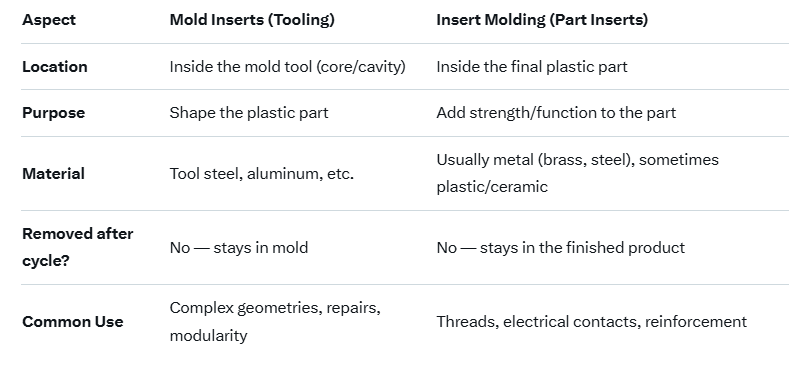
At Shenzhen Alu Rapid Prototype Precision Co., Ltd., we regularly design and build molds using both types of inserts:
1.Precision tooling inserts for complex or repairable molds (aluminum rapid tools or steel production molds).
2.Full insert molding capabilities for hybrid parts with metal components.
If you're designing a part and wondering whether tooling inserts or insert molding would help (or want examples/DMF feedback), feel free to share more details — CAD files, part function, volume, etc. We can guide you on the best approach and provide a quick quote.