
How do you calculate number of cavity for injection mold?
The number of cavities in an injection mold is not determined by a single universal formula — it's a balancing decision between technical constraints, economic goals, part quality requirements, and production volume. There is no simple "one equation fits all" answer, but several practical calculation methods and key factors help determine the reasonable/optimal number.Here are the most common approaches used in industry:
1.Production Volume & Economic Optimization (Most Important in Practice)
This method is used most often when deciding the actual number of cavities.
Basic logic
Number of cavities ≈ (Required annual / monthly quantity) ÷ (Number of shots possible per day × Working days)
More precisely, calculate to meet target piece price while amortizing mold cost:
Mold cost increases significantly with more cavities (more complex runner system, tighter tolerances needed, larger mold base)
Piece price decreases with more cavities (mold cost spread over more parts + faster production per hour)
Typical economic sweet spot (very rough guideline):
Small/medium precision parts, high volume (>100,000–1,000,000+ pcs/year) → 8–32–64 cavities
Medium volume → 4–16 cavities
Low volume or large/precision parts → 1–4 cavities
Many companies quote 1-cavity, 4-cavity, 8-cavity, and sometimes 16-cavity options to let the customer choose based on budget vs. speed.
2. Clamping Tonnage / Projected Area Method
One of the most frequently used technical checks.
Formula
Max. possible cavities = Machine clamping force (tons) ÷ (Projected area per cavity + runner area per cavity) × Material clamping factor (tons/in² or tons/cm²)Typical clamping factors (rule of thumb):PP, PE → ~2–3 tons/in²
ABS, PC, PA → ~3–5 tons/in²
Thin-wall or high-pressure materials → up to 5–8 tons/in²
Example:
Machine: 150-ton press
Part projected area: 12 cm²
Runner projected area per cavity: ~3 cm²
Material factor: 0.6 ton/cm² (≈ 3.9 ton/in²)
Total projected area allowed per cavity ≈ 150 ÷ 0.6 = 250 cm²
Max cavities ≈ 250 ÷ (12 + 3) ≈ 16.7 → max ~16 cavities (usually take 8 or 16 for balance)
3. Shot Weight / Injection Capacity Method
Checks whether the machine can fill all cavities + runners
Formula
Max. cavities = Machine shot weight (g) × Safety factor (usually 0.7–0.8) ÷ (Part weight + Runner weight per cavity)
Example:
Machine shot capacity: 200 g PS
Part weight: 8 g
Runner per cavity: 3 g
Total per cavity: 11 g
Max cavities ≈ (200 × 0.75) ÷ 11 ≈ 13.6 → realistically 8 or 12 cavities
4. Quick Layout / Mold Base Size Check
Very rough early-stage method:
Number of cavities ≈ Mold base usable area ÷ (Cavity footprint + spacing)
Commonly used to see if 4, 8, 16... fit symmetrically.
Summary Table – Key Constraints That Limit Cavity Number
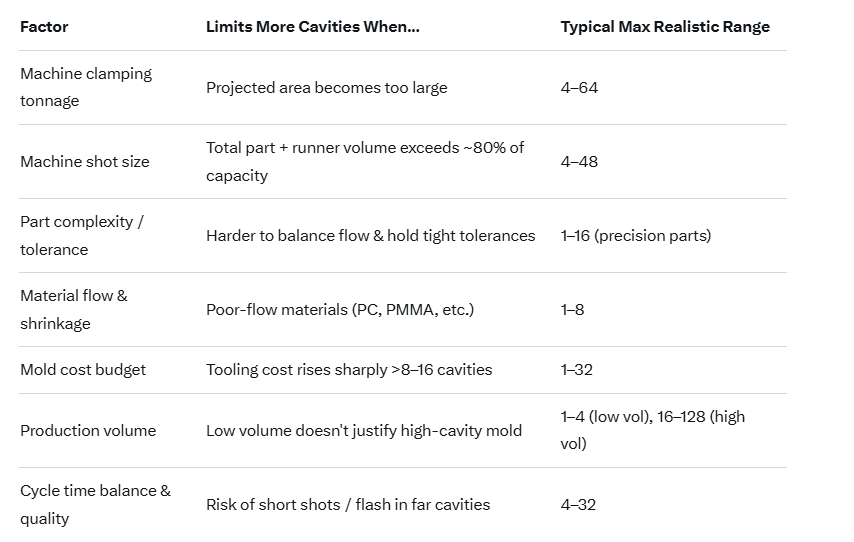
Bottom line recommendation
Start with required annual volume and target piece price → propose 1 / 4 / 8 / 16 cavity options → then check against the machine you plan to run (tonnage + shot size) using the projected area and shot weight calculations.If you give me more details (part projected area, part weight, material, expected annual quantity, available machine tonnage), we can help walk through a more specific calculation example.