
Custom plastic molding costs are typically split into two categories: the upfront tooling cost (the mold itself) and the per-part production cost.
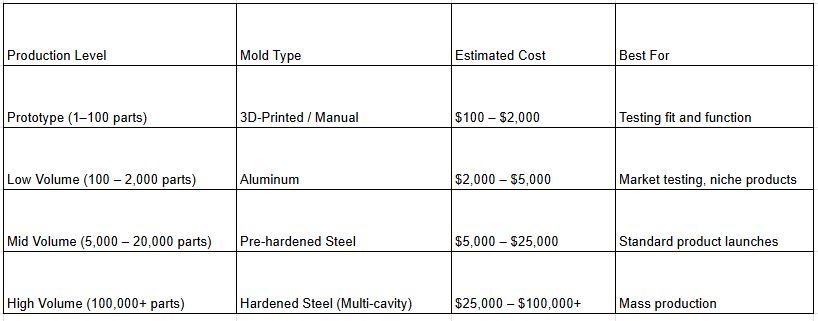
In 2026, the cost of a custom mold can range from $100 for a 3D-printed prototype to over $100,000 for high-volume steel production.
1. Upfront Tooling Costs (The Mold)
The mold is your biggest initial investment. The price depends heavily on the material of the mold and the complexity of your part.
2. Per-Part Production Costs
Once the mold is made, the cost per unit is usually very low. This is driven by three mainfactors:
Material: Commodity resins like Polypropylene (PP) or Polyethylene (PE) cost roughly$1.00 - $3.00 per kg, while engineering plastics like Polycarbonate (PC) or PEEK canexceed $25.00+ per kg.
Cycle Time: The longer a part takes to cool and eject, the more you pay for "machinetime" (typically $50 - $200 per hour).
Labor: Automated runs are cheaper; parts requiring manual trimming or assembly willcost more.
Example: A simple electronic housing might have a $15,000 mold cost. If you make1,000 units, each part costs $15.00 in tooling alone. If you make 100,000 units, thetooling cost drops to $0.15 per part.
3. Key Cost Drivers
Complexity: Features like undercuts, internal threads, or "side-actions" (parts of the mold that move) can increase the mold price by 30% to 50%.
Surface Finish: A high-gloss "mirror" finish or specific textures require manual polishing or chemical etching, adding significantly to the cost.
Number of Cavities: A "16-cavity" mold costs much more than a "single-cavity" mold but allows you to produce 16 parts in the same amount of time, slashing your long-term production costs.
Geography: Tooling made in China or Southeast Asia can often be 30% – 50% cheaper than molds made in North America or Europe, though shipping and quality oversight must be factored in.
How to lower your costs:
Simplify the design: Remove undercuts or complex textures if they aren't essential.
Use "Self-Mating" parts: Design your product so the left and right halves are identical; this allows you to use a single mold for both.
Optimize wall thickness: Thinner, uniform walls cool faster, which reduces cycle time and saves money on every single press.