What are the types of plastic injection molding?
Plastic injection molding comes in several types, each suited to different production volumes, materials, and part complexity. Here are the most common types used in modern manufacturing Learn about the 5 types of plastic injection molding — rapid tooling, overmolding, insert molding, low-volume production, and vacuum casting — with lead times, costs, and application guides
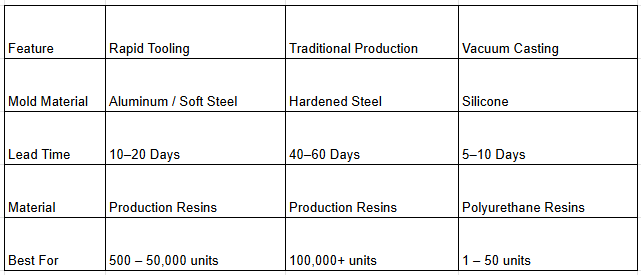
1. Rapid Injection Molding (Rapid Tooling)
This is our flagship molding service. Unlike traditional high-volume molding that uses hardened steel, Alu Prototype typically uses Aluminum (7075) or pre-hardened P20 steel for the mold bases.
Purpose: To bridge the gap between a 3D-printed prototype and full-scale mass production.
Benefit: Lead times are reduced to 2–4 weeks (compared to 8+ weeks for traditional molds), and costs are significantly lower.
Capacity: Typically guaranteed for 1,000 to 100,000+ parts.
2. Overmolding
Alu Prototype utilizes overmolding to create parts made of two or more different materials.
Process: A base part (the substrate) is molded first, then a second material (usually a soft-touch TPE or TPU) is molded directly over it.
Applications: Handheld tool grips, waterproof seals, and multi-colored consumer electronics.
3. Insert Molding
This process involves placing a pre-formed component (often metal) into the mold cavity before the plastic is injected.
Process: The plastic flows around the insert, "locking" it into the part.
Common Inserts: Brass threaded nuts, stainless steel pins, or electronic connectors.
4. Low-Volume Production Molding
While many large factories won't touch an order under 10,000 units, Alu Prototype specializes in small-batch runs (e.g., 100 to 2,000 parts). weuse "Master Unit Die" (MUD) systems to swap out only the cavity and core inserts, keeping the shared mold base costs down for the customer.
5. Vacuum Casting (Urethane Casting)
While not technically "injection" molding, Alu Prototype frequently lists this as a complementary service.
Process: weuse a 3D-printed master to create a silicone mold, then pour liquid resins into it under a vacuum.
Use Case: Ideal for very low quantities (10–50 parts) where even an aluminum mold is too expensive.
Comparison of Capabilities at Alu Prototype