
Is plastic molding a difficult process?
The short answer is: The concept is simple, but the execution is incredibly high-stakes.
Think of plastic molding like high-end baking. Getting the ingredients in the bowl is easy, but getting a soufflé to rise perfectly every single time without a single bubble or crack requires master-level control over temperature, timing, and chemistry.
Here is why plastic molding is considered "difficult" from an engineering perspective:
1. The "Shrinkage" Headache
Plastics expand when heated and shrink when cooled. If your part has thick sections and thin sections, they will cool at different rates. This leads to warping (the part twists like a potato chip) or sink marks (ugly dimples on the surface). Engineers have to calculate exactly how much the plastic will shrink—usually between 0.1% and 3%—and build the mold slightly "wrong" (larger) so the final part comes out "right."
2. The Science of "Gate" and "Venting"
You can't just pour plastic into a mold. It has to be injected at massive pressures (often over 10,000 psi).
Gating: You have to decide exactly where the plastic enters. If you put the "gate" in the wrong spot, you’ll get "knit lines" (visible seams where the plastic flows met) that are structural weak points.
Venting: As plastic rushes in, air has to go somewhere. If the mold isn't vented perfectly, the trapped air compresses, heats up, and literally burns the plastic, leaving black char marks on your part.
3. The Tooling Precision
A professional mold is a masterpiece of metalwork. The two halves of the mold must meet with such precision that the gap is smaller than a human hair (less than 0.02mm). If the gap is any wider, the pressurized plastic will leak out, creating "flash"—that thin, ugly fringe of plastic you sometimes see on cheap toys.
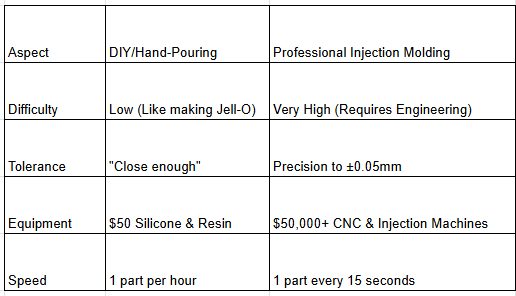
Comparison: DIY vs. Professional Molding
What makes it "Easy" for you?
While the process is difficult, it is "easy" for a designer if they follow DFM (Design for Manufacturing) rules:
Draft Angles: You must taper the walls of your part (usually 1° to 2°) so it can slide out of the mold. Trying to pull a straight-walled part out of a steel mold is like trying to get a suction cup off a window.
Uniform Wall Thickness: Keeping walls the same thickness throughout the part solves 80% of molding problems.
The "Golden Rule" of Molding
The more complex the part, the more expensive the "fix." > If you find a mistake after the steel mold is cut, it can cost thousands of dollars to weld and re-machine the metal. This is why our companies Shenzhen Alu Rapid Prototype are so popular—we use "soft" aluminum tools to catch these difficulties before you spend the big money on steel.