
At its core, a CNC (Computer Numerical Control) machine is a motorized tool that follows instructions from a computer to carve, cut, or shape materials like metal, wood, and plastic with incredible precision.
Think of it as a much more powerful, industrial version of a 3D printer, but instead of adding material layer by layer, most CNC machines subtract material to find the part hidden inside.
The Workflow: From Idea to Part
The process isn't just about the machine spinning; it's a three-step digital-to-physical handoff:
CAD (Computer-Aided Design): You create a 3D model of your part on a computer.
CAM (Computer-Aided Manufacturing): Special software converts that 3D model into G-Code. This is the language the machine speaks—a long list of coordinates like "move to X=10, Y=20, at speed 500."
The Controller: The CNC machine’s "brain" reads the G-Code and sends electrical signals to the motors to move the tools exactly as instructed
How the Hardware Moves
To achieve pinpoint accuracy, CNC machines use a system of axes and specialized motors.
1. The Cartesian Coordinate System
Most machines operate on at least three axes:
X-axis: Left to right.
Y-axis: Front to back.
Z-axis: Up and down (this usually controls the depth of the cut
2. Drive System
Unlike a manual lathe where a human turns a crank, a CNC machine uses Stepper or Servo motors. These are connected to lead screws (basically giant, precise threaded rods). When the motor turns, the screw rotates, moving the tool head or the worktable a fraction of a millimeter at a time.
3. The Spindle and Tooling
The spindle is the heart of the action. it holds the cutting tool (like an end mill or drill bit) and spins at high speeds—sometimes over 20,000 RPM—to slice through the material.
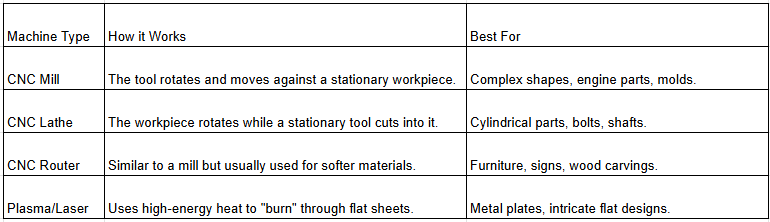
Common Types of CNC Machines
Why Use CNC?
Consistency: Once the program is written, the machine can make 1,000 identical parts without getting tired or making a "human error" typo.
Complexity: They can create geometries that would be impossible for a human to track manually.
Safety: The operator stays behind a shield, away from flying sparks and sharp blades.