
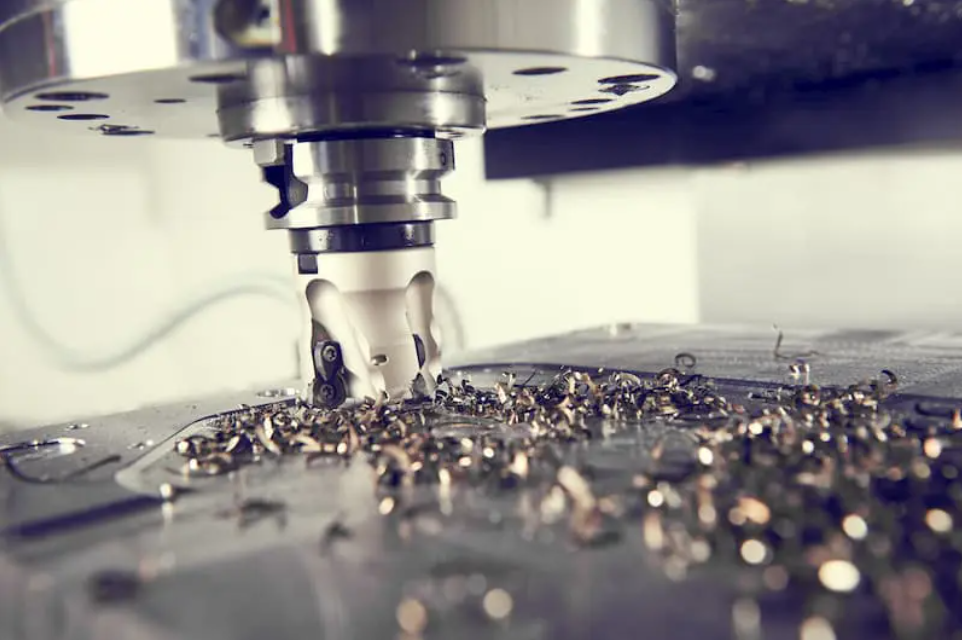
CNC machines (Computer Numerical Control machines) are automated manufacturing tools that precisely cut, drill, mill, turn, or shape materials (like metal, plastic, wood, or composites) based on computer instructions — basically turning a digital design into a real physical part with very high accuracy and repeatability.
How a CNC Machine Works — Step by Step
Here’s the typical flow from idea → finished part:
1.Design the part in CAD software
An engineer or designer creates a 2D drawing or (most commonly) a 3D model using software like SolidWorks, Fusion 360, AutoCAD, etc. This digital model shows exactly what the final part should look like, including all dimensions and features.
2.Convert the design to machine instructions (CAM programming)
CAM software (Computer-Aided Manufacturing) takes the 3D model and generates toolpaths — the exact routes the cutting tool will follow.
It decides: Which tool to use (end mill, drill, turning insert…)
Cutting speed (RPM)
Feed rate (how fast the tool moves through material)
Depth of cut
Coolant on/off, etc.
The software then outputs this as G-code (and some M-code), a simple text-based language that the machine understands (e.g., G01 X10 Y20 F150 means "move linearly to X=10 Y=20 at feedrate 150").
3.Set up the physical machine
Fix the raw material (workpiece) securely on the table / in a chuck / vise
Install the correct tools in the spindle or tool magazine
Set workpiece zero point (where X=0, Y=0, Z=0 is)
Load the G-code file into the machine controller
4.The machine executes the program
The CNC controller reads the G-code line by line and sends signals to servo/stepper motors.
These motors move different axes very precisely (usually via ballscrews or linear rails).
Common axes: X = left-right
Y = front-back
Z = up-down (depth)
Many machines add A/B/C rotary axes or 4th/5th axis for complex shapes
The spindle spins the cutting tool (or the workpiece in a lathe) at high speed, and the machine removes material layer by layer until the final shape appears.
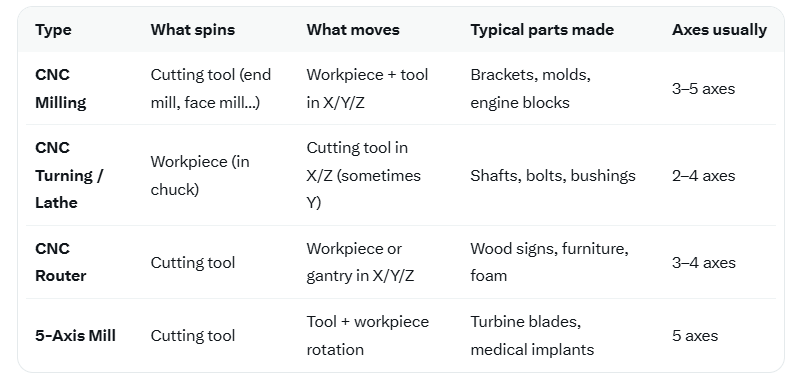
Main Types of CNC Machines (and How They Move)
Quick Summary – Why CNC is Powerful
1.Extremely precise (±0.01 mm or better is common)
2.Repeatable — the 1000th part is identical to the first
3.Works 24/7 with minimal supervision once set up
4.Can make very complex geometries that are almost impossible manually