Injection molding (also called injection moulding) is the most common manufacturing process for producing high-volume plastic parts with excellent repeatability, tight tolerances, and good surface finish. It is widely used for everything from phone cases and automotive components to medical devices and toys.
The process works by melting thermoplastic material and forcing (injecting) it under high pressure into a precisely machined metal mold, where it cools and solidifies into the desired shape. A full production cycle typically takes 10–60 seconds depending on part size, thickness, and material.
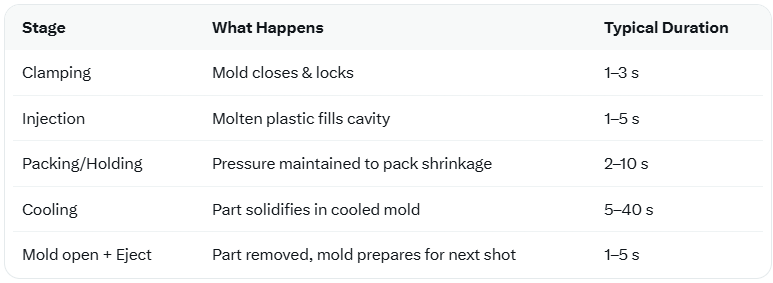
Here are the main stages of a typical injection molding cycle:
1.Clamping
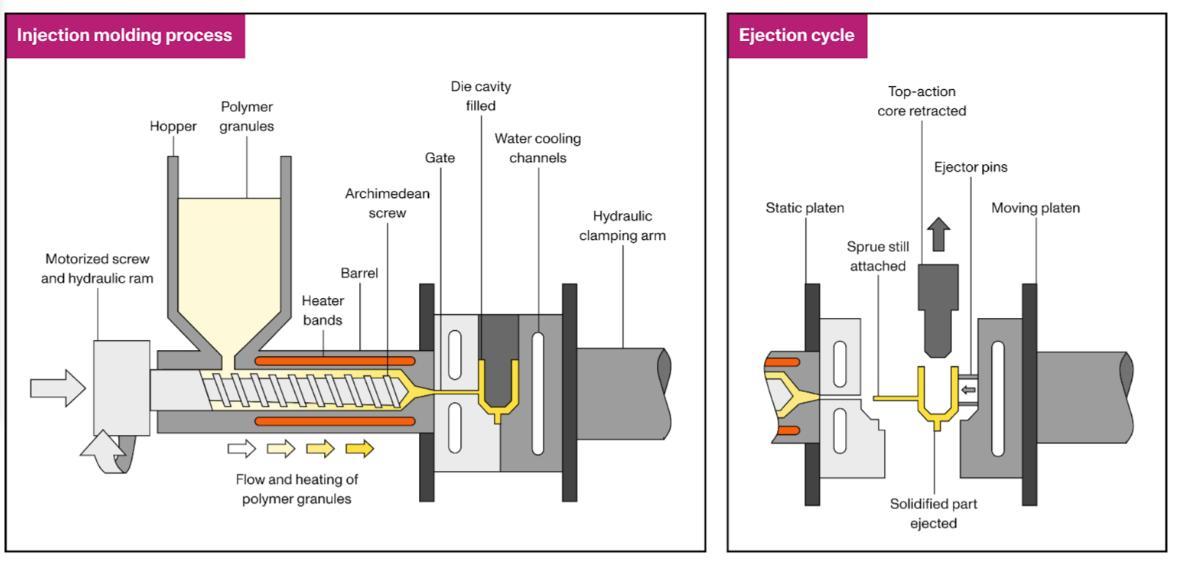
The mold (usually made of steel or aluminum and consisting of two halves — a core and a cavity) is closed and clamped together with enormous force (often hundreds to thousands of tons) to withstand the high injection pressure without opening.
This prevents the mold from flashing (plastic leaking out).
2.Injection (Filling)
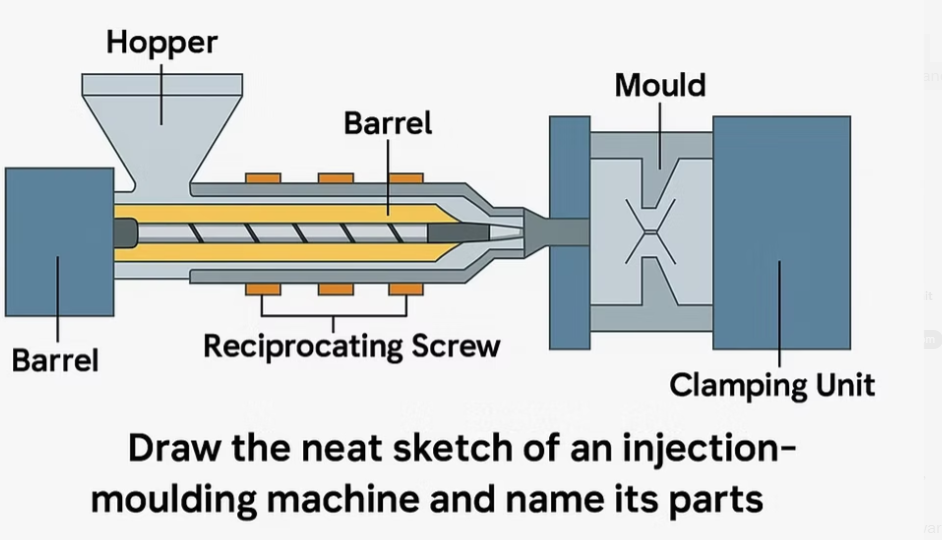
Plastic pellets (granules/resin) are fed from a hopper into a heated barrel.
A rotating reciprocating screw inside the barrel melts the plastic through a combination of friction (shear) and external heater bands (usually 180–300°C depending on the material, e.g., PP, ABS, PA, PC).
Once enough molten plastic (a "shot") has accumulated in front of the screw, the screw moves forward like a plunger and injects the molten material at high speed and pressure (typically 500–2,000 bar) through the nozzle, sprue, runners, and gates into the mold cavity.
3.Packing / Holding (Dwell / Pressure Phase)
After the cavity is filled, the machine maintains pressure for a short time (usually a few seconds).
This compensates for shrinkage as the plastic cools and solidifies → prevents sink marks, voids, and incomplete filling.
During this phase the screw may move forward slightly to pack more material.
4.Cooling
The mold is actively cooled (usually with water channels) while the part solidifies.
Cooling time is typically the longest part of the cycle (50–70% of total cycle time) and is critical for dimensional stability and avoiding warpage.
The material transitions from a viscous melt → rubbery → glassy/solid state.
5.Mold Opening & Ejection
Once the part is rigid enough, the clamping force is released and the mold opens.
Ejector pins, air blasts, or robotic arms push/strip the solidified part (and runner system if cold runner) out of the mold.
The mold closes again → cycle repeats.
Quick Summary of One Complete Cycle