
Zinc is often considered the "gold standard" for die casting, especially for precision components like those produced by Shenzhen Alu Rapid Prototype Precision Co., Ltd. Its popularity stems from a unique combination of physical properties that make it easier to work with than aluminum or magnesium.
Here is why zinc is a top-tier choice for the die casting process:
1. Superior Fluidity and Thin Walls
Zinc has incredible "flow" when molten. This fluidity allows it to fill incredibly intricate molds and produce much thinner walls than other metals.
The Benefit: You can design complex, "net-shape" parts that require little to no secondary machining, saving time and money.
Wall Thickness: Zinc can consistently achieve wall thicknesses under 0.5 mm, whereas aluminum typically struggles below 1.5 mm.
2. High Ductility and Impact Strength
Unlike many cast metals that become brittle, zinc alloys (like Zamak) are remarkably tough.
Impact Strength: Zinc has higher impact resistance than aluminum and magnesium alloys.
Secondary Operations: Because it is ductile, zinc parts can be crimped, riveted, or formed after casting without cracking.
3. Extended Tooling Life
This is perhaps the biggest financial advantage. Zinc has a relatively low melting point (roughly 380°C to 390°C).
Thermal Shock: Because the metal isn't as hot when it hits the mold, the steel dies suffer less thermal fatigue.
Longevity: A zinc die can often last for 1 million+ cycles, while an aluminum die might only last 100,000 cycles before requiring expensive repairs or replacement.
4. High-Speed Production (Hot Chamber)
Zinc is typically used in a Hot Chamber die casting machine. In this setup, the injection mechanism is submerged in the molten metal.
Speed: This allows for much faster "shots" because the metal doesn't have to be ladled from a separate furnace for every cycle.
Consistency: It results in a more stable temperature and fewer air pockets (porosity) in the final part.
5. Excellent Finishing Options
Zinc is a very "friendly" substrate for aesthetic coatings. Its smooth surface finish out of the mold makes it the ideal candidate for:
Chrome Plating: (Common in automotive and plumbing).
Powder Coating: For durable, colorful finishes.
Electroplating: To enhance corrosion resistance or electrical conductivity.
Comparison Table: Zinc vs. Aluminum
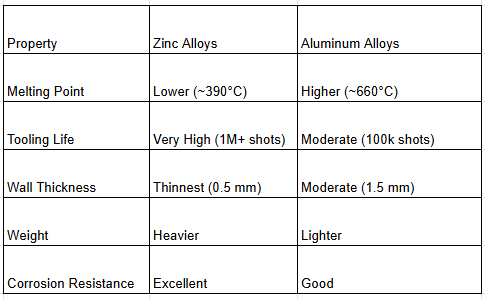
While zinc is heavier than aluminum, its strength and the ability to cast thinner walls often mean you can use less material to achieve the same structural integrity.