
In the world of manufacturing, injection molding is the undisputed king of speed and volume. The time it takes to create a single part is known as the cycle time.
For most plastic parts, a full cycle typically takes anywhere from 10 to 60 seconds, though highly complex or massive components can take several minutes.
The Anatomy of a Cycle
To understand the speed, you have to look at what happens inside the machine. A single "shot" follows this sequence:
1.Clamping (1–5 sec): The two halves of the mold are pressed together with immense pressure.
2.Injection (1–6 sec): Molten plastic is shoved into the mold cavity.
3.Cooling (10–100+ sec): This is the bottleneck. The part must solidify enough to keep its shape. This stage usually accounts for 60% to 80% of the total cycle time.
4.Ejection (1–5 sec): The mold opens, pins push the part out, and the cycle resets.
Factors That Hit the Gas (or the Brakes)
1.Wall Thickness: This is the biggest speed killer. If a part is twice as thick, it takes four times as long to cool. Engineers aim for thin, uniform walls to keep things moving.
2.Material Type: Some plastics (like polyethylene) dissipate heat faster than others.
3.Multi-Cavity Molds: While the cycle time might be 30 seconds, a mold with 64 cavities produces 64 parts in that window—effectively making a part every 0.46 seconds.
4.Cooling Systems: High-end molds use "conformal cooling" (internal water channels that follow the shape of the part) to suck heat out faster.
Comparison at a Glance
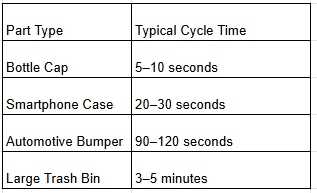
Pro Tip: If you're designing a part, keeping your wall thickness under 3mm is the "sweet spot" for fast, cost-effective production.