What is electronic design and prototyping?
Electronic design and prototyping is the process of taking a conceptual circuit and transforming it into a functional, physical device. It bridges the gap between a theoretical "idea" and a mass-producible product, focusing on power management, signal integrity, and physical form factor.
In the context of high-precision manufacturing and international trade, this process is what dictates the final "bill of materials" (BOM) and the housing requirements for the device.
1. Electronic Design: The Blueprint
This phase is purely digital and focused on the logic of the system.
Schematic Capture: Creating a logical map of the circuit. This defines how componentslike microcontrollers, sensors, and power regulators connect.
PCB Layout (Physical Design): Translating the schematic into a physical Printed CircuitBoard. This involves "routing" copper traces to carry signals without interference.
High-Speed Design: Managing impedance for data signals (e.g., USB, Ethernet).
Thermal Management: Designing copper "heat sinks" to dissipate heat from powercomponents.
Firmware Development: Writing the code (usually in C or C++) that tells the hardwarehow to behave.
2. Prototyping Stages
Prototyping is iterative, moving from "messy but functional" to "production-ready."
Stage A: Breadboarding (Proof of Concept)
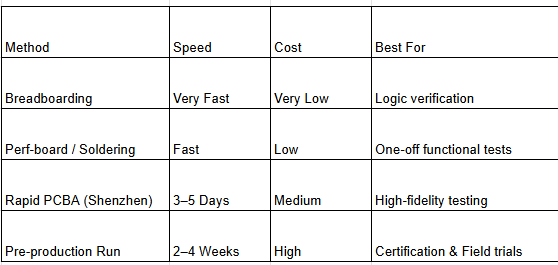
Using a plug-and-play board to test the basic code and circuit logic. No soldering is required here.Goal: Does the sensor talk to the screen? Does the motor spin?
Stage B: PCBA Prototyping (Alpha)
A custom Printed Circuit Board Assembly (PCBA) is fabricated. These are often "green boards" produced in small batches (5–10 units).
SMT Assembly: Components are soldered using Surface Mount Technology (SMT).
Testing: Using multimeters and oscilloscopes to verify voltage levels and signal timing.
Stage C: Integrated Prototype (Beta)
The electronics are fitted into a custom-designed enclosure (often CNC machined or 3D printed).
Form Factor Check: Ensuring the PCBA fits perfectly within the mounting brackets.
User Interface: Testing the tactile feel of buttons or the visibility of LEDs through the housing.
3. Key Considerations for Industrial Applications
If you are designing for sectors like door access systems or automotive electronics, the prototyping requirements are much stricter:
EMC/EMI Compliance: Ensuring the electronics don't interfere with other devices (crucial for European CE marking).
Environmental Protection: Designing the PCBA for "potting" or conformal coating if it will be exposed to moisture or dust.
Component Sourcing: Selecting parts with long lifecycles to avoid "obsolescence" during the manufacturing run.
Comparison of Prototyping Methods