Creating a PVC (Polyvinyl Chloride) injection mold requires a specialized approach because PVC is thermally sensitive and chemically corrosive when melted. To build a durable and effective mold, you must focus on material selection and thermal management.
Here is a breakdown of the essential steps and technical considerations:
1. Material Selection (The "Anti-Corrosion" Layer)
When PVC is heated, it can release hydrochloric acid, which will pit and corrode standard tool steels.
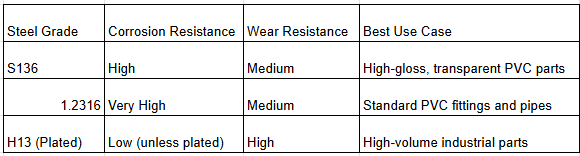
Stainless Steel: Use high-chromium stainless steels like 1.2083, 1.2316, or S136. These offer the necessary corrosion resistance.
Surface Treatment: If using non-stainless steel, the mold must be hard chrome plated or chemically nickel-plated to protect the surfaces.
Core and Cavity: Ensure these are polished to a high mirror finish to prevent the material from sticking and degrading in "dead spots."
2. Design Specifications
PVC has a relatively high viscosity and flows poorly compared to materials like PE or PP.
Gate Design: Use wide, thick gates (fan gates or disk gates) to reduce shear heat. Smallgates can cause "burning" or streaking.
Runner System: Keep runners as short and thick as possible. A full-round runner is idealfor maintaining even pressure and flow.
Draft Angles: PVC is rigid and can be difficult to eject. Use a generous draft angle-typically 1.5° to 2°-to ensure the part releases without dragging.
3. Thermal and Venting Control
Venting: This is the most critical safety and quality step. Because PVC gas is corrosive,you need deep, wide vents (around 0.02mm to 0.05mm) to allow gas to escape quickly. Ifgas is trapped, it will cause "burn marks" on the part and damage the mold.
Cooling Channels: PVC has low thermal conductivity. Design intensive, uniform coolingchannels to maintain a stable mold temperature (usually between 30°C and 60°C) toprevent warping.
4. Manufacturing Process
1.CNC Machining: Rough cut the mold base and cavities.
2.Heat Treatment: Harden the steel to roughly 48–52 HRC to withstand the high injection pressures.
3.EDM & Polishing: Use Electrical Discharge Machining for fine details, followed by meticulous hand-polishing.
4.Fitting: Ensure the parting lines are perfectly tight to prevent "flashing," as PVC flows easily into tiny gaps under pressure.
Comparison of Steel Types for PVC Molds