
Designing an injection mold—specifically through the lens of high-precision providers like Shenzhen Alu Rapid Prototype Precision Co., Ltd—requires a shift from theoretical design to "Design for Manufacturing" (DFM).
Since they specialize in rapid prototyping and high-precision CNC/die casting, their workflow often prioritizes speed and material integrity. Here is the technical roadmap for designing a mold suitable for such precision environments.
1. Geometric Analysis & Parting Line
The first step in any PDF design manual is defining how the mold opens.
Parting Line Selection: Locate the parting line at the widest cross-section of the part.For precision aluminum components, ensure the line doesn't interfere with critical sealingsurfaces.
Draft Angles: For rapid prototyping, a minimum draft of 0.5° to 1.0° is required for mostsurfaces. If the part has a heavy texture (EDM finish), increase this to 3°-5°.
2. Material-Specific Shrinkage
Precision shops like Alu Rapid often work with technical resins (PEEK, PC-ASA) or metals. Yourdesign must scale the cavity to account for shrinkage (S):
Lm =Ipx(1+ S)
Where Lm is the mold dimension and Lp is the part dimension.
Rigid PVC: 0.1% - 0.5%
Aluminum (Die Cast): ~0.4% - 0.6%
3. Feed System Design (Gate & Runner)
For rapid tooling, "Cold Runner" systems are common due to lower cost and faster setup.
Gate Type: Use Edge Gates for easy manual trimming or Sub-gates for automatic degating.
Runner Profile: A trapezoidal or full-round runner is preferred to minimize pressure drop.
4. Cooling and Ejection
Conformal Cooling: If the part is complex, design cooling channels that follow the contour of the part. This reduces cycle time and prevents warping.
Ejection: Place ejector pins on non-aesthetic "B-side" surfaces. Ensure pins are placed at deep ribs or bosses where the part is most likely to stick.
Technical Checklist for "Alu Rapid" Style Prototyping
If you are preparing a design for a quote from a precision shop in Shenzhen, your documentation should include:
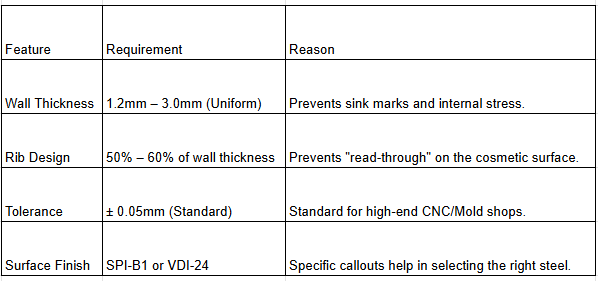
How to Structure Your Design PDF
1.If you are creating a manual or a technical spec sheet, organize it as follows:
2.Project Scope: Material (e.g., Pure Aluminum or PC), expected volume (Prototype vs. Production).
3.2D Engineering Drawing: Highlight critical tolerances and GD&T (Geometric Dimensioning and Tolerancing).
4.3D Step File: Clean geometry with all draft angles included.
5.DFM Report: Notes on gate locations, parting lines, and any "thin steel" areas that might break.