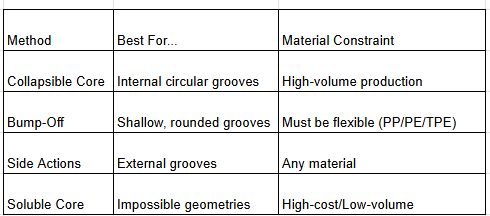
Achieving a groove or a recessed feature without a visible parting line is a classic challenge in mold design. In a standard "open-and-shut" mold, a groove usually creates an undercut—a feature that prevents the part from being ejected.
To get around this without leaving a witness mark (parting line) on the aesthetic surface, you generally have three primary engineering options:
1. Internal Collapsible Cores
This is the "gold standard" for molding circular internal grooves (like a snap-fit ring inside a cap).
1.How it works: The core is made of segments that physically collapse inward once the mold opens. This reduces the core's diameter, allowing the molded groove to clear the steel as the part is pushed off.
2.Benefit: It provides a seamless 360° internal groove with no parting lines.
3.Trade-off: These components are expensive and require high maintenance.
2. The "Bump-Off" (Forced De-molding)
If your material is flexible enough (like PE, PP, or some TPEs) and the groove is shallow with a lead-in radius, you can "bump" the part off a solid core.
1.How it works: The natural elasticity of the plastic allows the part to stretch momentarily over the steel undercut during ejection.
2.The Secret: The groove must have a radius rather than sharp 90° corners. If the undercut is too deep or the material too rigid (like Polycarbonate), the part will crack.
3.Parting Line: Since the core is one solid piece, there is no parting line inside the groove.
3. Sliding Side Actions (External Grooves)
If the groove is on the outside of the part and you want to avoid a parting line, you must hide the "shut-off" point.
1.The Strategy: Design the mold so the sliding block (the "side action") creates the entire exterior surface of the part where the groove sits.
2.The Result: The parting line is moved to a natural corner or an edge of the part where it is invisible to the user, rather than running right through the center of the groove.
4. Lost Core or Soluble Inserts
For extremely complex internal geometries where a collapsible core cannot fit:
1.How it works: A secondary piece (the "core") is molded from a low-melting-point alloy or a water-soluble polymer and placed inside the main mold. After the plastic is injected and cooled, the part is removed, and the core is melted or dissolved away.
2.Benefit: Zero parting lines and total design freedom.
3.Trade-off: Extremely slow and expensive; usually reserved for high-end automotive manifolds or aerospace parts.
Summary of Selection