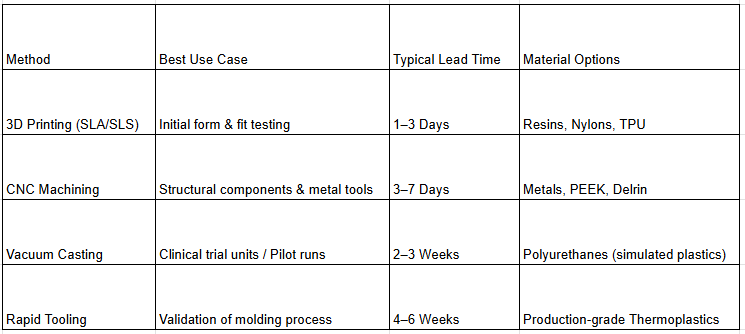
Selecting a prototyping method for medical devices requires balancing functional testing, biocompatibility requirements, and the transition to high-volume manufacturing. Because medical hardware often involves complex geometries and strict material standards, the choice usually shifts as you move from "looks-like" models to "works-like" clinical prototypes.
1. 3D Printing (Additive Manufacturing)
This is the standard for early-stage iterative design. It allows for rapid adjustments to ergonomics and form factors without the cost of tooling.
SLA (Stereolithography): Best for high-resolution, smooth surfaces (e.g., hearing aids, dental guides). Some resins are Class VI biocompatible for short-term skin contact.
SLS (Selective Laser Sintering): Uses nylon powders to create durable, functional parts with complex internal geometries. It is ideal for "works-like" prototypes that need to withstand mechanical stress.
DMLS (Direct Metal Laser Sintering): Essential for orthopedic implants or surgical tools requiring stainless steel or titanium.
2. CNC Machining
When the prototype requires production-grade materials (like PEEK, 316L Stainless Steel, or 6061 Aluminum), CNC machining is the most reliable method.
Precision: Offers tighter tolerances than most 3D printing methods.
Material Integrity: Unlike 3D printing, CNC parts are carved from a solid block, ensuring there are no layer-line weaknesses or porosity—critical for pressurized fluidics or high-load components.
Verification: Used to validate the mechanical properties of a device before committing to expensive injection molds.
3. Vacuum Casting (Urethane Casting)
This bridges the gap between 3D printing and injection molding. A 3D-printed master pattern is used to create a silicone mold, which is then used to cast parts.
Short Runs: Ideal for 10–50 units for clinical trials or user testing.
Overmolding: Excellent for prototyping handheld devices that require a rigid internal frame with a soft, rubberized "overmold" for grip.
Surface Finish: Provides a professional, injection-molded look and feel at a fraction of the initial cost.
Comparison Table: Prototyping Selection