What is magnesium alloy casting?
Magnesium alloy casting is a manufacturing process where molten magnesium is injected or poured into a mold to create lightweight, high-strength parts. In the context of Shenzhen Alu Rapid Prototype Precision Co., Ltd. (and the broader Shenzhen precision manufacturing cluster), this typically refers to high-pressure die casting or rapid prototyping using magnesium alloys like AZ91D or AM60B.
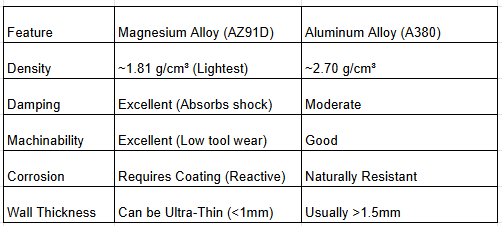
Magnesium is the lightest structural metal available, being approximately 33% lighter than aluminum and 75% lighter than steel, making it a "gold standard" for weight reduction.
1. Key Magnesium Alloys Used
In precision shops like those in Shenzhen, you will primarily encounter:
AZ91D: The most common die-casting alloy. It offers an excellent balance of castability,high strength, and good corrosion resistance.
AM60B/AM50A: Known for higher ductility and energy absorption. These are often usedfor safety-critical parts (like automotive steering wheels or seat frames) that must deformrather than snap upon impact.
ZK60 / WE43: Specialized alloys used when high-temperature stability or specificmechanical properties are required, often seen in aerospace or high-end medicalprototypes.
2. Why Choose Magnesium Over Aluminum?
While both are common in Shenzhen's "Rapid Prototype" ecosystem, magnesium offers specific technical advantages:
Thinner Wall Sections: Magnesium has better fluidity than aluminum, allowing for wallthicknesses as thin as 0.5mm to 1.Omm, which is difficult to achieve with aluminumwithout defects.
Vibration Damping: It has much higher damping capacity than aluminum, making it idealfor housing sensitive electronics or medical imaging equipment.
Faster Cycle Times: Magnesium has a lower heat content per unit volume, so it coolsfaster in the mold. This can lead to 20-30% faster production cycles compared toaluminum. +1
Tool Life: Because magnesium is less "aggressive" to steel molds (it doesn't chemicallyattack the die like aluminum does), your casting molds can last significantly longer-oftenup to 200,000+ shots。
3. Applications in Medical & Tech
Given your focus on precision and high-performance materials, magnesium casting is particularly useful for:
Handheld Surgical Tools: Reducing weight to minimize surgeon fatigue during long procedures.
Portable Medical Monitors: Providing a lightweight, rugged chassis that also acts as an EMI/RFI shield.
Orthopedic Implants: Specialized magnesium alloys are actually bio-resorbable, meaning they can slowly dissolve in the body as bone heals, potentially eliminating the need for a second surgery to remove hardware.
Comparison: Magnesium vs. Aluminum Casting