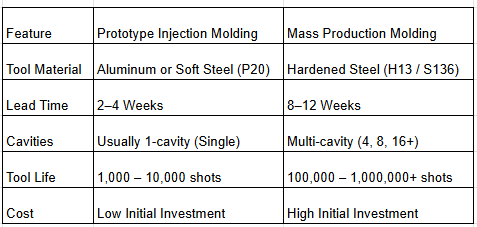
The primary purpose of Prototype Plastic Injection Molding (often called Rapid Tooling) is to bridge the gap between a 3D-printed model and full-scale mass production. It allows you to test your product using production-grade materials and actual manufacturing processes before investing tens of thousands of dollars in permanent steel molds.In the precision manufacturing landscape—especially within high-tech hubs like Shenzhen—this process is critical for validating both the design and the business case.
1. Material Functional Testing
While 3D printing can simulate the look of a part, it cannot perfectly replicate the mechanical properties of high-performance engineering plastics.
1.True Performance: If your device requires PA66 with 30% Glass Fiber or PEEK, aprototype mold allows you to test the actual strength, heat resistance, and chemicaldurability of the part.
2.Environment Testing: You can perform "torture tests" like drop testing, UV exposure, orsterilization cycles (Autoclave/EtO) that 3D-printed resins would fail.
2. Design for Manufacturing (DFM) Validation
A prototype mold reveals "real-world" molding issues that CAD software might miss:
1.Sink Marks & Warpage: It identifies areas where walls are too thick or cooling is uneven, which is vital for long parts (like 1.2m covers) or complex valve housings.
2.Gate & Venting Locations: You can optimize where the plastic enters the mold to ensure structural integrity and minimize cosmetic blemishes.
3.Cycle Time Estimation: It provides an accurate baseline for how long it takes to produce one part, which is essential for final unit cost calculations.
3. Bridge Production & Market Entry
Prototype tooling is often used for "Bridge Production" to get products to market while the final high-volume steel tools (which can take 8–12 weeks) are being fabricated.
1.Pilot Runs: Typically produces 50 to 5,000 units.
2.Clinical/Field Trials: Provides "final-quality" parts for regulatory testing (like ISO 10993) or user feedback sessions.
3.Lower Financial Risk: Since prototype molds are usually made from Aluminum (7075) or Pre-hardened Steel (P20), they are significantly cheaper and faster to produce than multi-cavity hardened steel molds.
Prototype vs. Production Molding Comparison