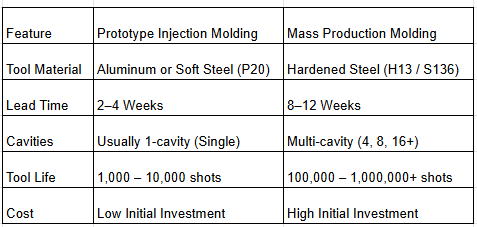
The advantages of prototype plastic injection molding lie in its ability to simulate mass production at a fraction of the cost and time. While 3D printing is excellent for visual models, prototype molding is the "truth test" for any part intended for a commercial market.
In precision engineering—especially for components like valve housings or high-pressure seals—the following advantages are the most critical:
1. Production-Grade Material Testing
The biggest limitation of 3D printing (SLA/FDM) is that the materials are "simulants." Prototype molding uses the actual resin intended for the final product.
1.Mechanical Accuracy: You can test the true tensile strength, impact resistance, and flexibility of engineering plastics like PEEK, PA66 + Glass Fiber, or POM (Delrin).
2.Chemical & Heat Resistance: Essential for medical or industrial parts that must undergo sterilization (Autoclave) or contact harsh chemicals.
3.Color and Texture: It allows for the exact Pantone color matching and surface textures (MT or VDI) required for the final "out-of-the-box" user experience.
2. Validation of Complex Geometries
Prototype molding identifies physical manufacturing risks that a computer simulation (Moldflow) might miss.
1.Gate & Flow Analysis: You can see exactly how the molten plastic fills the cavity, identifying potential knit lines (where plastic meets) that could become structural weak points.
2.Internal Stresses: It reveals if a part will warp or "sink" after it cools, which is particularly important for long, thin-walled parts like 1.2-meter covers or shields.
3.Interchangeable Inserts: For product families with multiple sizes (e.g., DN80 to DN150), you can use a single "Master Mold Base" with interchangeable inserts to test different versions cost-effectively.
3. Bridge Production Capabilities
Prototype tooling (often made from Aluminum 7075 or P20 steel) serves as a bridge while the high-volume "Hard Tooling" is being built.
1.Speed to Market: You can produce 50 to 5,000 parts in weeks rather than months, allowing you to start sales or clinical trials early.
2.Regulatory Approval: Provides the exact parts needed for ISO 10993 (biocompatibility) or UL safety certifications, which often require "production-process" samples.
4. Cost-Effective Iteration
While more expensive than a single 3D print, prototype molding is significantly cheaper than a full-scale production mold.
1.Lower Initial Risk: If a design flaw is found, modifying an aluminum prototype mold is fast and inexpensive compared to modifying a hardened steel production mold.
2.Tooling Life: Even a "rapid" mold can typically handle several thousand shots, making the cost-per-part much lower than CNC machining or 3D printing for mid-range quantities.
Comparison of Prototyping Benefits