Why Injection Molding Quotes Vary Between Suppliers?
Getting multiple quotes for an injection molding project can feel like looking at a different language for each line item. While one supplier might offer a "bargain" price, another might be triple the cost for what seems like the same plastic part.
The variation usually boils down to how a supplier balances initial investment (CAPEX) versus long-term part cost (OPEX), and the level of risk they are willing to absorb.
1. Tooling Classification (SPI Standards)
The biggest price driver is the mold itself. Suppliers quote based on different "Classes" defined by the Plastics Industry Association (SPI):
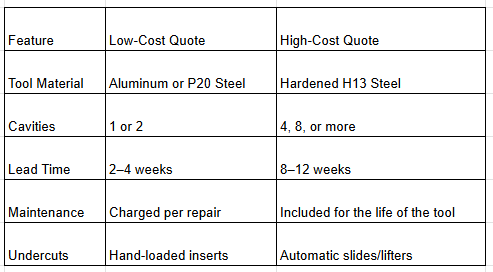
Class 101: Built for over 1 million cycles. These use high-grade hardened tool steel (like H13), complex cooling channels, and guided components. They are expensive up front but offer the lowest cost-per-part over time.
Class 103/104: Built for low-to-mid volumes (under 100k cycles). These might use aluminum or P20 "soft" steel. The mold is much cheaper, but it will wear out faster and may require more maintenance.
2. Cavitation and Cycle Time
A quote for a single-cavity mold will be significantly cheaper than an 8-cavity mold. However, the 8-cavity mold produces eight parts in the same amount of time it takes the single-cavity mold to make one.
High Quote: Likely includes more cavities to reduce your piece-price for high-volume production.
Low Quote: Likely a single-cavity "prototype" tool, which leads to a much higher price per part.
3. Mold Complexity and Automation
How the part is removed from the mold affects the price:
Manual Inserts: If a part has "undercuts" (features that prevent it from being pushed straight out), a supplier might use manual inserts that an operator picks out by hand. This keeps the mold cheap but spikes the labor cost.
Automatic Actions: Using hydraulic slides or "lifters" to handle undercuts automatically adds thousands to the tooling cost but automates the process for efficiency.
4. Machine Hourly Rates and Tonnage
Suppliers have different overhead costs based on their equipment. A 500-ton press costs more to run per hour than a 50-ton press. If one supplier plans to run your part on an oversized machine because that's all they have available, those costs are passed to you.
5. Material Sourcing and Additives
Even if the material is the same (e.g., PA66 with 30% Glass Fiber), prices vary based on:
Brand name vs. Generic: Using DuPont Zytel vs. a local high-quality compounder.
Regrind Ratio: Some suppliers quote based on 100% virgin resin, while others may factor in a percentage of "regrind" (recycled scrap) to lower the price.
Comparison Table: Why Quotes Differ