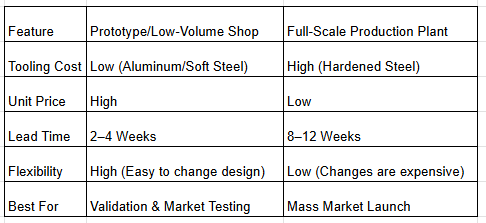
Choosing a custom manufacturing supplier is less about finding the "best" factory and more about finding the best fit for your specific production volume, technical complexity, and risk tolerance. A supplier built for million-part automotive runs will be a poor match for a 500-unit medical device prototype, and vice versa.
To vet effectively, use this tiered strategic framework:
1. Technical Alignment (The "Capability" Filter)
Before discussing price, you must verify that their equipment and expertise match your part's geometry and material requirements.
Machine Tonnage & Envelope: Ensure they have the right press sizes. Using an oversized machine for a small part (or vice versa) leads to poor cycle times and higher costs.
Material Specialization: If your part requires high-performance resins (like PEEK) or high glass-fiber content (like PA66 + 30% GF), confirm they have the high-temperature heaters and wear-resistant screws/barrels to handle them.
Secondary Operations: Does the project require ultrasonic welding, CNC post-machining, or specific surface treatments? A "one-stop shop" reduces logistics risks but might be more expensive than a specialist.
2. Tooling & Engineering Philosophy
The way a supplier approaches a mold or a fixture tells you everything about their long-term quality.
DFM (Design for Manufacturing) Support: A top-tier supplier won't just say "yes." They will provide a DFM report highlighting potential sink marks, thin walls, or difficult-to-cool areas.
Mold Standards: Ask which SPI Class they quote by default. You want to ensure they aren't quoting a "soft" steel tool (like P20) for a project that requires 500,000 cycles.
Interchangeability: For projects with multiple versions of the same part, ask about their experience with interchangeable inserts. This can save significant costs by using one master mold base for different part geometries.
3. Quality Management & Certification
Certifications are the baseline, but the application of quality is what matters.
ISO 9001 vs. Industry Specific: For general parts, ISO 9001 is standard. For automotive, look for IATF 16949; for medical, ISO 13485.
Inspection Equipment: Ask for their equipment list. Do they use manual calipers, or do they have CMM (Coordinate Measuring Machine) and OGP (Optical Gaging Products) for high-precision tolerances?
Traceability: Can they provide material certifications (COA) and batch-specific processing logs if a failure occurs in the field?
4. Communication & Project Management
In custom manufacturing, the biggest "hidden cost" is the time spent chasing updates.
The Single Point of Contact: Does the supplier provide a dedicated project manager who understands the technical nuances?
Language & Time Zone: If sourcing internationally, evaluate their English proficiency and their "overlap" hours. A 12-hour delay in communication can add weeks to a tight schedule.
Transparency: A good supplier is honest about delays. Ask them: "What is your current capacity, and how do you handle a machine breakdown during a production run?"
Comparison: Prototype Shop vs. Production Partner