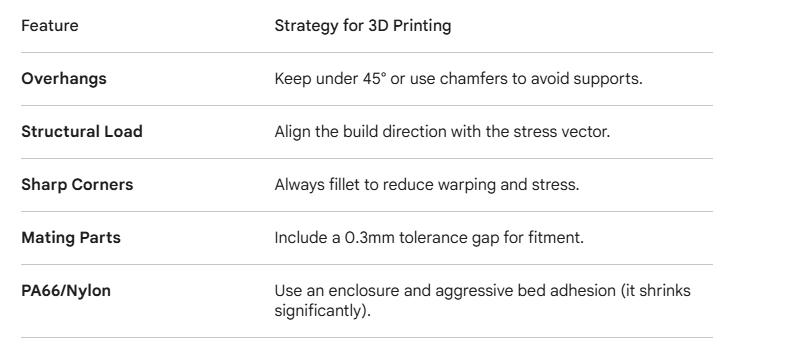
Designing for 3D Printing (Additive Manufacturing) requires a different mindset than traditional CNC machining or injection molding. Because the part is built layer-by-layer, factors like orientation, support structures, and thermal stress dictate success.
Since you are working on functional prototypes like your ShortKut aluminum chair components or PA66 valve parts, here are the critical strategies to optimize your designs:
1. Master Part Orientation
Orientation is the most important decision you make. It affects strength, surface finish, and the amount of support material needed.
Anisotropy: Remember that 3D-printed parts are weakest along the Z-axis (the direction of layering). If your knife gate valve component needs to withstand high pressure, orient the part so the primary load is applied parallel to the layer lines, not perpendicular to them.
Minimize Supports: Orient the model so that features requiring supports are minimized. Large overhangs (usually >45 degrees) will require support material, which leaves marks on the surface and increases post-processing time.
2. Design for "Self-Supporting" Geometry
Where possible, design features that don't require support structures:
Chamfers over Fillets: For downward-facing edges, use chamfers (angled cuts) rather than rounded fillets. A 45-degree chamfer can be printed without supports, whereas a fillet creates a shallow angle that often requires support.
Bridge Elements: If you have two vertical walls with a horizontal span, design the span as a flat or arched bridge. Many printers can handle "bridging" (stretching material across a gap) effectively without supports if the distance is kept short.
3. Wall Thickness and Infill Strategy
Don't treat 3D-printed parts like solid blocks.
Minimum Thickness: Ensure walls are at least 0.8mm-1.2mm thick to prevent warpingand ensure structural integrity.
Strategic Infill: Instead of printing at 100% density, use variable infill. Use higher density(e.g., 40%+) at the "skins" (top/bottom/sides) where stress is concentrated, and lowerdensity in the core to save time and material.
Honeycomb/Gyroid Infill: If the part is functional, use a Gyroid infill pattern; it isisotropic (provides equal strength in all directions) and has excellent fatigue resistance.
4. Manage Thermal Contraction
Particularly with high-performance plastics like PA66 (Nylon), thermal shrinkage is a major challenge.
Fillets at Sharp Corners: Avoid sharp internal corners. They create stress risers where the part is likely to crack or peel away from the build plate (delamination). Add fillets to all interior corners to distribute stress.
Consistent Wall Thickness: Large changes in cross-sectional area lead to uneven cooling. If one side of your part is thick and the other is thin, the thick side will cool slower, leading to warping. Try to maintain uniform wall thicknesses throughout.
5. Tolerances and Assembly
If your design involves mating parts (e.g., the handle of your barber chair sliding into a receiver):
Clearance: You cannot expect "zero-clearance" fits like you get with CNC machining. Add a clearance gap of at least 0.2mm–0.4mm between mating parts.
"Print-in-Place": If you are designing an assembly, try to model it to be printed in one go (like a living hinge or a snap-fit). This reduces the need for assembly and fasteners.
Summary Checklist for Your Projects