Vacuum Forming Vs Injection Molding: Which One is Best?
Choosing between vacuum forming and injection molding depends entirely on the stage of your product's lifecycle and the specific requirements of your component (like the valve bodies or chair parts you are developing).
Here is a breakdown to help you decide which process is right for your project:
1. Vacuum Forming (Thermoforming)
Vacuum forming involves heating a sheet of plastic until it is pliable and then sucking it onto a single-sided mold using a vacuum.
Best For: Large, simple parts like enclosures, trays, panels, or covers.
Pros:
Tooling Cost: Very low. Molds can be made of wood, resin, or aluminum.
Speed: Molds are fast to produce.
Flexibility: Great for prototypes or small-batch runs (1–500 units).
Cons:
Geometric Limits: Cannot produce complex parts with undercuts, deep internal channels, or thick walls.
Wall Thickness: Inconsistent. The plastic thins out as it stretches over the mold.
Finish: One side will be smooth (the side against the mold), but the other side will have a textured or "raw" finish.
2. Injection Molding
Injection molding involves injecting molten plastic (like your PA66 with 30% glass fiber) into a two-part metal mold under high pressure.
Best For: Complex, high-precision parts that require tight tolerances, consistent wall thickness, and high strength.
Pros:
Precision: Exceptional accuracy and repeatability for thousands of units.
Complexity: Can create intricate details like threads, snap-fits, and internal ribbing.
Performance: The high pressure allows for glass-filled materials (like your PA66) to flow properly and retain structural integrity.
Cons:
Tooling Cost: High. Steel or aluminum molds require precision CNC machining and are expensive.
Lead Time: Building a production-grade mold can take weeks.
Design Rigidity: Once the mold is cut, changes are extremely difficult and costly.
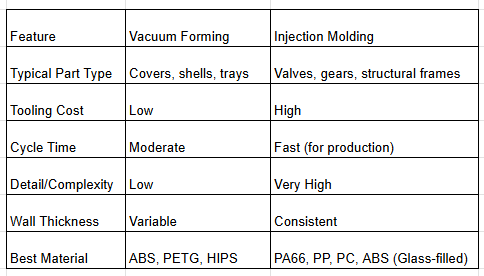
Comparison Summary