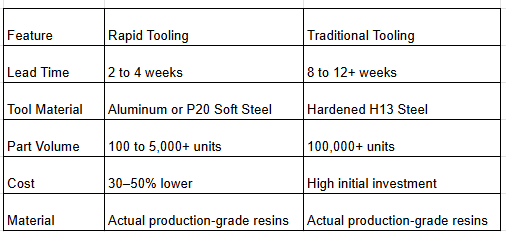
Rapid tooling, often referred to as bridge tooling or prototype tooling, is a manufacturing process used to produce molds, dies, or patterns significantly faster and at a lower cost than traditional, fully hardened production steel tooling.
In the context of companies like Shenzhen Alu Rapid Prototype Precision Co., Ltd. (often operating under the brand RpProto), rapid tooling is a core service used to bridge the gap between initial 3D-printed prototypes and full-scale mass production. It allows you to produce functional parts in their final production materials (like PA66 + GF or specific Aluminum alloys) for testing or low-volume market entry.
How Rapid Tooling Works
Instead of carving a complex mold out of expensive hardened steel (which can take months), rapid tooling uses materials and methods that prioritize speed.
1.Aluminum Tooling: Using high-strength aluminum (like 7075) for mold cavities. Aluminum dissipates heat faster than steel, which can shorten cycle times, and it is much faster to CNC machine.
2.Modular Mold Bases: Utilizing "Master Mold Bases" where only the core and cavity inserts are custom-made for your part. This saves the time and cost of building a completely new mold structure.
3.3D Printed Inserts: For extremely complex geometries, metal 3D printing (DMLS) can be used to create inserts with conformal cooling channels—cooling lines that follow the part's shape—which are impossible to make with traditional drilling.
4.Soft Tooling (Indirect): Creating a master pattern via 3D printing and then casting a silicone or epoxy mold around it (often used in vacuum casting).
Key Advantages for Your Projects
For a firm managing projects like transitioning industrial knife gate valves from metal to plastic, rapid tooling offers specific strategic benefits: