
What is permanent die casting?
In modern manufacturing, selecting the right casting method can make or break a project's efficiency, cost, and product quality. While there are numerous ways to shape molten metal, permanent mold die casting (often referred to simply as permanent mold casting) stands out as a premier choice for high-volume, high-strength components.
But what exactly is permanent die casting, and is it the right choice for your next manufacturing run? Let's dive deep into how this process works, its key benefits, and how it compares to other casting methods.
What is Permanent Mold Die Casting?
Permanent mold die casting is a metal casting process that employs reusable molds—usually machined from high-melting-point metals like steel, cast iron, or graphite. Unlike sand casting, where the mold is destroyed after a single use, a permanent mold can be used tens of thousands of times.
This process is primarily used for non-ferrous metals and alloys, such as:
Aluminum (the most common)
Magnesium
Copper and Brass
Zinc
How the Permanent Mold Casting Process Works
The permanent mold casting process relies heavily on gravity or low pressure to fill the mold, which distinguishes it from traditional high-pressure die casting. Here is the step-by-step breakdown:
Mold Preparation: The two halves of the metal mold are cleaned and preheated to an optimal temperature. A refractory coating (a heat-resistant lubricant) is sprayed into the cavity. This protects the mold from thermal shock and makes it easier to remove the finished part.
Clamping: The mold halves are securely clamped together. If the part requires internal cavities, sand or metal cores are inserted at this stage.
Pouring: Molten metal is poured directly into the mold, usually via a funnel or gating system. In gravity permanent mold casting, gravity alone pulls the liquid metal into the cavity. In low-pressure permanent mold casting, low-pressure gas pushes the metal upward into the mold.
Cooling and Solidification: The metal cools rapidly due to the high thermal conductivity of the steel or iron mold.
Ejection: Once solidified, the mold is opened, and mechanical ejector pins push the hot casting out.
Trimming and Finishing: Excess material from the gates and risers is trimmed off, leaving a near-net-shape component ready for final finishing or minimal machining.
Key Advantages of Permanent Die Casting
Why do engineers and project managers choose permanent mold casting over sand casting or high-pressure die casting?
1. Superior Mechanical Properties
Because metal molds cool the molten metal much faster than sand molds, the resulting grain structure of the metal is incredibly fine. This rapid solidification translates to higher tensile strength, better ductility, and superior structural integrity—making it ideal for load-bearing parts.
2. Excellent Dimensional Accuracy and Surface Finish
Permanent molds maintain their shape perfectly across thousands of cycles. This allows for exceptionally tight tolerances and a smooth surface finish that significantly reduces—or entirely eliminates—the need for costly post-cast machining.
3. Lower Porosity
Compared to high-pressure die casting, gravity permanent mold casting introduces very little air into the mold cavity. This results in much lower internal porosity, meaning the parts are less prone to hidden defects and are highly reliable.
4. Cost-Effective for Medium to High Volumes
While the initial cost of tooling (creating the steel mold) is higher than sand casting, the mold lasts for thousands of runs. The fast cycle times and minimal secondary machining make the cost-per-part incredibly economical for mid-to-high volume production.
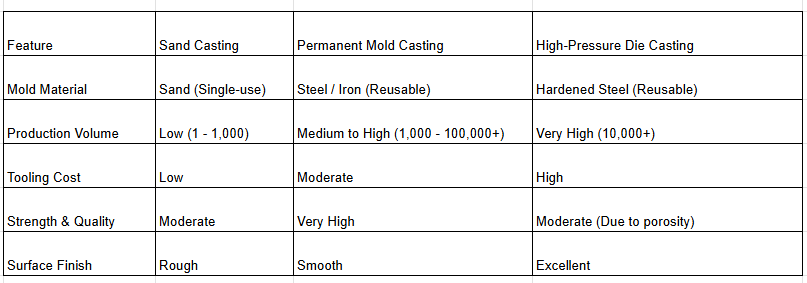
Permanent Mold vs. Sand Casting vs. Pressure Die Casting
To help you choose the right method, here is a quick comparison table:
Common Applications
Thanks to its blend of strength and precision, permanent mold die casting is widely utilized across demanding industries:
Automotive: Engine blocks, pistons, cylinder heads, suspension components, and wheels.
Aerospace: Structural brackets, fuel system components, and housing units where strength-to-weight ratio is critical.
Industrial Machinery: Gears, pumps, impellers, and heavy-duty valves.
Defense & Marine: Marine hardware and military-grade structural components that require high resistance to corrosion and stress.
Is Permanent Mold Casting Right for Your Project?
If your project requires high-strength aluminum or magnesium parts, demands a smooth surface finish, and has a production volume ranging from a few thousand to tens of thousands of units, permanent mold die casting is likely your most cost-effective and high-quality solution.
Want to learn more? (Contact:https://aluprototype.com/contactus/)Index to discuss your project specifications, or request a free quote to see how our permanent mold casting services can optimize your supply chain.