
What Is a Compound Die?
In high-precision manufacturing, choosing the right metal stamping process can make or break your project’s budget and quality. If your project requires high-volume production of flat, intricate metal parts with tight tolerances, a compound die is often the most efficient and cost-effective tool for the job.
But what exactly is a compound die, and how does it compare to other stamping methods like progressive dies?
In this comprehensive guide, we will break down the mechanics, benefits, and applications of compound dies, and help you determine if it is the right choice for your next manufacturing project.
What is a Compound Die?
A compound die is a specialized metal stamping tool that performs multiple cutting operations—such as blanking, piercing, and punching—in a single press stroke at a single station.
Unlike other stamping methods where the metal sheet moves across different stations to be cut sequentially, a compound die holds the material stationary while all cuts are made simultaneously. This ensures unparalleled accuracy and concentricity between the internal features (like holes or slots) and the external perimeter of the part.
How Does a Compound Die Work?
Material Feeding: The metal sheet or strip is fed into the single-station die.
The Single Stroke: The stamping press comes down. The upper and lower halves of the die engage.
Simultaneous Cutting: In that single fraction of a second, the internal holes are pierced at the same time the outer shape is blanked (cut out).
Part Ejection: The finished, flat part is ejected from the die, often using a spring-loaded stripper plate, while the scrap is separated.
Compound Die vs. Progressive Die: What’s the Difference?
When sourcing custom metal stamping services, you will likely choose between a compound die and a progressive die. Here is a quick comparison to help you understand the core differences:
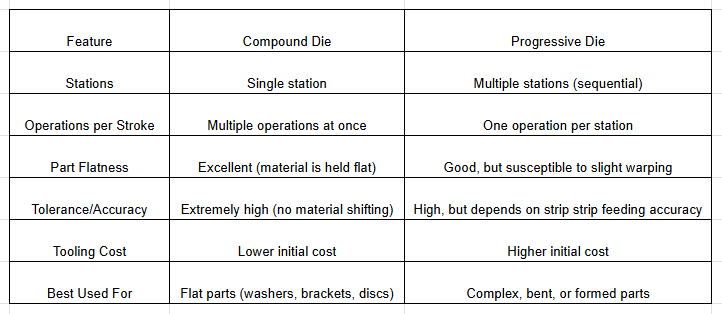
Key Benefits of Using Compound Dies
1. Superior Dimensional Accuracy
Because all cuts happen at the exact same time without the metal strip moving, there is zero risk of the material shifting between operations. This results in perfect concentricity and incredibly tight tolerances, making it ideal for components that require flawless precision.
2. Maximum Flatness
Compound dies apply uniform pressure across the entire part during the stroke. If your component cannot tolerate warping or bending (such as shim rings or electrical laminations), compound stamping is the gold standard.
3. Lower Tooling Investment
Compared to complex progressive dies that require multiple stations and intricate alignment mechanisms, compound dies are simpler to design and manufacture. This translates to lower upfront tooling costs for your business.
4. High Material Efficiency
Compound dies can be designed to nest parts tightly together on the raw metal sheet, significantly reducing scrap metal waste and lowering your overall material costs.
Common Applications of Compound Die Stamping
Compound dies are widely used across industries like automotive, electronics, aerospace, and medical device manufacturing. They are perfect for producing flat components, including:
Washers and Shims: Standard and custom-sized flat washers.
Electrical Laminations: Highly precise, flat steel sheets used in electric motors and transformers.
Brackets and Plates: Simple, flat mounting brackets with multiple hole configurations.
Gaskets and Seals: Precision-cut metallic seals.
Is a Compound Die Right for Your Project?
While compound dies offer massive advantages, they aren't the solution for every design. A compound die is the ideal choice if your project fits the following criteria:
The part is completely flat (no bends, draws, or forms).
The design requires extremely tight tolerances and perfect hole-to-edge alignment.
You need to produce parts in medium-to-high volumes efficiently.
If your part requires complex 3D bending, deep drawing, or threading, a progressive die or a multi-stage forming process would be a better fit.
Get Precision Custom Metal Stamping at AluPrototype
At AluPrototype, we specialize in delivering world-class rapid prototyping and high-volume production solutions. Our state-of-the-art metal stamping services include expert compound die design and manufacturing, ensuring your flat metal parts are produced with maximum accuracy, minimal waste, and rapid turnaround times.
Whether you need a prototype run or high-volume production, our engineering team is here to help you optimize your design for manufacturability (DFM) to save you time and money.
Ready to bring your project to life?Contact AluPrototype Today for a fast, free quote and expert engineering support!