
Composite mold in Applications in the Lighting Industry
The global lighting industry is undergoing a massive transformation. From sleek, aerodynamic automotive headlights to explosion-proof industrial luminaires and architectural streetlights, modern lighting designs demand complex geometries, superior thermal management, and extreme durability.
To meet these challenging requirements, manufacturers are shifting away from traditional heavy metals and turning to composite materials (such as carbon fiber, fiber-reinforced plastics (FRP), and sheet molding compounds (SMC)).
But how are these advanced composites shaped into flawless, high-performance lighting fixtures? The secret lies in composite molds and the high-precision CNC tooling used to create them.
In this article, we will explore the critical role of composite molds in the lighting industry, their key benefits, and why precision tooling is the backbone of modern lighting manufacturing.
What is a Composite Mold?
In manufacturing, a composite mold (often referred to as composite tooling) is a mold made from composite materials (such as epoxy resins reinforced with carbon fiber or fiberglass) rather than traditional solid steel or aluminum.
Additionally, "composite molding" refers to the process of using highly precise metal molds (such as aluminum or steel molds) to press, inject, or cast composite materials (like SMC or BMC) into their final, high-strength shapes.
For the lighting industry, both definitions are vital:
Tooling: Lightweight composite molds are used to cast complex, large-scale outdoor light poles or architectural fixtures.
Production: Precision-machined aluminum and steel molds are used in Compression Molding or Resin Transfer Molding (RTM) to produce high-performance composite lighting enclosures.
Why the Lighting Industry is Choosing Composite Molding
Traditional metal housings (like die-cast aluminum or sheet metal) have long been the standard for light fixtures. However, composite molded components are rapidly replacing metals across several key lighting sectors due to their outstanding material properties:
1. Seamless Part Consolidation
Modern lighting designs—especially in the automotive and architectural sectors—require complex shapes with integrated mounting brackets, wiring channels, and heat sink cavities. Composite molding allows engineers to consolidate what used to be a 10-piece metal assembly into a single, highly complex molded part. This drastically reduces assembly time and production costs.
2. Superior Environmental & Corrosion Resistance
Outdoor streetlights, coastal architectural lighting, and industrial explosion-proof fixtures are constantly exposed to moisture, salt spray, UV radiation, and harsh chemicals. Unlike metals, composites do not rust or corrode. Utilizing composite molds ensures that the finished housings have incredibly smooth surface finishes that resist weathering for decades.
3. Electrical Insulation and Safety
Composites are naturally non-conductive. For street lighting, underground luminaires, and wet-location lighting, using composite housings eliminates the risk of electrical shock, making the end products much safer and reducing the need for complex grounding wires.
4. Lightweighting with High Strength
In automotive headlight design, saving weight is directly tied to improving vehicle efficiency (especially for electric vehicles). Composite parts shaped by high-precision molds offer the strength of steel or aluminum at a fraction of the weight, giving automotive designers more freedom to create aerodynamic, wrap-around headlamp housings.
Key Applications of Composite Molding in Lighting
Composite molds are deployed across a wide range of lighting sectors to manufacture high-performance components:
Automotive Headlights and Taillights: Complex, multi-cavity molds are used to create the structural back-housings of modern LED headlight assemblies, where dimensional stability under heat is critical.
Industrial & Explosion-Proof Lighting: Heavy-duty compression molds shape thick glass-fiber-reinforced composites into explosion-proof housings for chemical plants, marine environments, and mining facilities.
Smart Streetlight Enclosures: Modern streetlights host 5G nodes, cameras, and sensors. Composite housings allow radio signals to pass through easily, whereas metal housings would block them (RF transparency).
High-End Architectural Fixtures: Closed-mold RTM (Resin Transfer Molding) processes yield flawlessly smooth, paint-ready surfaces for designer interior and exterior fixtures.
The Core of Success: Precision Mold Tooling
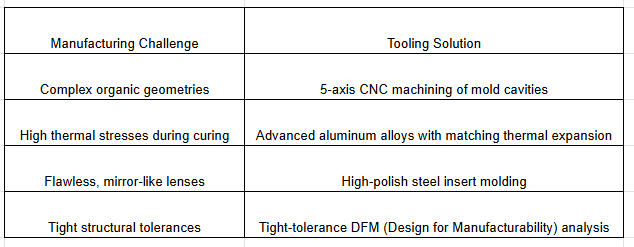
No composite part can be better than the mold that shapes it. Because composite materials expand and contract during the curing process, the molds must be designed with extreme precision.
To achieve this, manufacturers rely on high-precision CNC machining and rapid prototyping to create the master patterns (plugs) and the production molds themselves.
Partner with AluPrototype for Your Lighting Mold & Tooling Needs
At AluPrototype, we understand that the lighting industry demands a perfect balance of aesthetics, thermal performance, and structural integrity.
We specialize in high-precision rapid tooling, CNC machining, and custom mold manufacturing to support your composite molding projects. Whether you are producing complex automotive headlight prototypes, high-durability outdoor lighting enclosures, or rapid pre-production tooling, our engineering team is ready to optimize your designs for flawless manufacturing.
5-Axis CNC Precision: We machine complex mold cavities with tight tolerances to ensure your composite parts fit perfectly every time.
DFM Expert Support: We analyze your CAD designs to minimize draft angles, improve resin flow, and reduce tooling costs.
Rapid Turnaround: Transition from prototype to production-grade molds in record time.
Bring your next lighting innovation to market faster.Contact AluPrototype Today for an instant quote and expert technical consultation!