
What are the limitations of composite material molds?
Composite material molds—often made from carbon fiber, fiberglass, and specialized epoxy resins—have carved out a specific niche in modern manufacturing. They are frequently praised for their lightweight nature, low thermal expansion, and suitability for producing large, low-volume components like aerospace panels or boat hulls.
However, while composite tooling offers unique advantages for specific niche applications, it is not the ultimate solution for every manufacturing project. In high-volume, high-precision, or high-temperature environments, composite molds often fall short compared to traditional CNC-machined metal molds.
If you are evaluating tooling options for your next production run, understanding the limitations of composite material molds is critical to avoiding costly production delays and quality issues.
1. Shorter Tool Life and Lower Durability
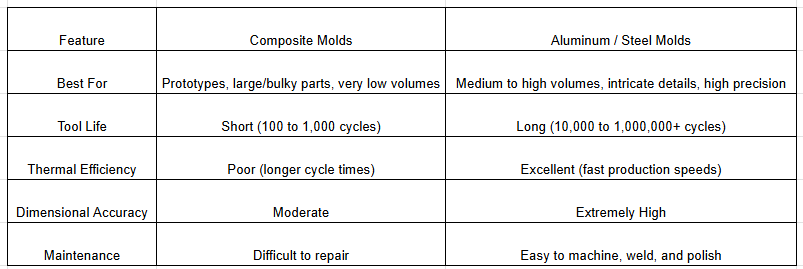
The most significant limitation of a composite mold is its overall lifespan. While hardened steel molds can withstand millions of injection or compression cycles, and aluminum molds can easily handle tens of thousands, composite molds degrade much faster.
The epoxy and fiber surfaces are highly susceptible to abrasion, scratching, and general wear and tear from the constant loading and demolding of parts. For anything beyond prototyping or low-volume runs, composite tooling often requires frequent resurfacing or complete replacement, driving up long-term costs.
2. Poor Thermal Conductivity
In molding processes like injection molding or thermoforming, cycle time is heavily dependent on how fast the mold can cool the part.
Metal Molds: Aluminum and steel have excellent thermal conductivity, rapidly drawing heat away from the part and allowing for incredibly fast cycle times.
Composite Molds: Epoxy resins and carbon fibers are natural insulators. They retain heat, which significantly slows down the cooling process. This extended cycle time makes composite molds highly inefficient for mass production.
3. High-Temperature Degradation
Composite molds have a strict glass transition temperature (Tg)—the point at which the resin begins to soften. When subjected to the repeated high temperatures required for molding advanced engineering plastics, composite tools can experience thermal fatigue, micro-cracking, and warping.
While high-temperature resins exist, they are extremely expensive and still do not match the thermal stability of CNC-machined aluminum or P20 tool steel.
4. Maintenance and Repair Challenges
When a metal mold is scratched or damaged, it can often be welded, polished, or re-machined back to its original tolerance. Repairing a composite mold is a much more complex and less reliable process.
Patching a damaged composite surface requires applying new resin, curing it, and hand-sanding it back to the correct geometry. It is very difficult to achieve the original dimensional accuracy and surface finish after a repair, often resulting in visible defects on the final molded parts.
5. Challenges with Tight Tolerances
Because composite molds are typically laid up over a master pattern (plug) and undergo chemical curing processes, they are subject to slight shrinkage and warpage during their own manufacturing. Achieving the extremely tight micro-tolerances required in industries like automotive electronics or medical devices is incredibly difficult with composite tooling.
By contrast, 5-axis CNC machining allows metal molds to be cut directly from a solid block of material to exact CAD specifications, ensuring flawless precision.
Composite Molds vs. Metal Molds: Which Should You Choose?
To make the best tooling decision for your project, consider this quick comparison:
Get High-Precision Metal Tooling at AluPrototype
While composite molds have their place in niche, low-volume applications, CNC-machined metal molds remain the undisputed standard for precision, durability, and cost-effective mass production.
At Shenzhen Alu Rapid Prototype Precision Co., Ltd, we specialize in delivering world-class rapid tooling, CNC machining, and custom mold manufacturing. Whether you need rapid aluminum tooling to test a prototype or high-grade hardened steel molds for millions of parts, our engineering team ensures your project is manufactured to the tightest tolerances.
Do not let subpar tooling slow down your production line or compromise your product quality.
Ready to upgrade your manufacturing strategy?Contact AluPrototype Today for a free design-for-manufacturability (DFM) review and an instant quote on precision metal tooling!