
Key Technologies Behind Modern Prototype Machining Services
In product development, speed, precision, and material integrity are everything. Before committing to mass production, engineers and designers rely on prototype machining services to validate designs, perform functional testing, and secure stakeholder approval.
However, prototype machining is no longer just about basic milling and turning. Today, the rapid prototyping industry is driven by an advanced suite of interconnected software, multi-axis hardware, and precision inspection tools.
If you are looking to bring a custom metal or plastic part to market, understanding the key technologies involved in prototype machining will help you choose the right manufacturing partner and optimize your design for production.
1. Advanced CAD and CAM Integration
Every successful prototype begins as a digital concept. The seamless translation of a 3D model into high-precision machine movements relies on two critical software systems:
Computer-Aided Design (CAD): Software like SolidWorks, CATIA, or Autodesk Inventor allows engineers to define complex geometries, specify tolerances, and design for manufacturability (DFM).
Computer-Aided Manufacturing (CAM): CAM software (such as Mastercam or Hypermill) converts the 3D CAD model into G-code—the program that tells the CNC machine exactly how to move, which tools to select, and what speeds to run. Modern CAM tools simulate the entire machining process in virtual reality first, eliminating tool collisions and optimizing machining paths to save material and time.
2. Multi-Axis CNC Machining (3-Axis to 5-Axis)
Computer Numerical Control (CNC) machining is the undisputed backbone of subtractive rapid prototyping. By automating high-speed cutting tools, CNC machines can carve prototypes out of solid blocks of metal (like aluminum, steel, titanium, and brass) or engineering plastics (like PEEK, POM/Delrin, and polycarbonate).
Depending on the complexity of your prototype, different CNC configurations are used:
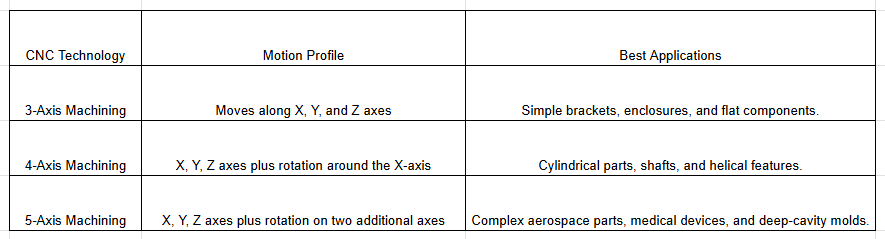
Why 5-Axis Machining Matters
For intricate prototypes, 5-axis CNC milling allows the cutting tool to approach the workpiece from virtually any angle. This eliminates the need for multiple manual setups, vastly reducing human error, lowering manufacturing costs, and achieving exceptional geometric tolerances in a single run.
3. High-Speed Machining (HSM) and Adaptive Milling
Time-to-market is the ultimate metric in rapid prototyping. High-Speed Machining (HSM) technology employs extremely fast spindle speeds (often exceeding 20,000 RPM) paired with advanced, constant-load toolpaths known as adaptive milling.
Instead of making slow, deep cuts that heat up the material and stress the tooling, HSM makes fast, shallow cuts. This technology offers several distinct benefits:
Reduced Thermal Stress: Heat is carried away in the metal chips, keeping the prototype structurally stable.
Mirror-Like Surface Finishes: Reduces the need for extensive manual post-processing and polishing.
Faster Turnarounds: Cuts down machining time by up to 50% compared to traditional milling.
4. Electrical Discharge Machining (EDM)
When prototypes feature complex, delicate internal geometries—such as sharp 90-degree internal corners, micro-grooves, or ultra-thin walls—traditional rotating cutting tools cannot physically machine them. This is where Electrical Discharge Machining (EDM) excels.
Wire EDM: Uses a continuously moving, thin brass wire carrying an electrical charge to slice through conductive metals. It acts like a surgical laser, cutting complex outlines with tolerances as tight as ±0.002 mm.
Sinker EDM (Spark Erosion): Uses a custom-machined copper or graphite electrode plunged into the material to "burn" away the metal in the exact reverse shape of the electrode. This is highly utilized for machining deep cavities in hard tool steel.
5. Metrology and Precision Inspection Technology
A precision prototype is only as good as the technology used to verify its accuracy. Modern prototype machining facilities utilize high-tech inspection systems to ensure every part matches the CAD file down to the micron:
Coordinate Measuring Machines (CMM): Multi-axis CMM probes physically touch key coordinates of the prototype, comparing them directly to the original 3D CAD model to ensure dimensional compliance.
Optical & Laser Scanners: Non-contact 3D scanners project blue-light patterns or lasers onto the finished prototype, creating a high-density "point cloud" digital twin to inspect surface profiles and complex organic shapes quickly.
Accelerate Your Product Development with AluPrototype
Selecting the right prototype machining service means choosing a partner who invests in the latest manufacturing technologies.
At Shenzhen Alu Rapid Prototype Precision Co., Ltd, we leverage advanced CAD/CAM workflows, high-speed 3-axis to 5-axis CNC machining, precision EDM, and rigorous CMM inspection to bring your designs to life with unmatched speed and accuracy.
Whether you need a single functional prototype in aluminum or a low-volume run of complex parts, our experienced engineering team provides comprehensive Design for Manufacturability (DFM) feedback to optimize your parts for cost, quality, and performance.
Get your design moving today.Contact AluPrototype Now for an instant quote and expert technical consultation