
Why CNC Plastic Machining Prototypes Matter in Product Development
When bringing a new product to market, the physical prototyping phase is where digital concepts meet physical reality. While 3D printing often dominates the conversation around rapid prototyping, it is not always the best tool for the job—especially when you need to test the true mechanical properties of a plastic component.
For functional testing, assembly verification, and low-volume pre-production, CNC plastic machining remains an indispensable technology.
But why exactly does CNC plastic machining matter so much in modern manufacturing? Let's explore the critical advantages this subtractive manufacturing process offers and why it is the ultimate risk-management strategy before moving to mass production.
1. Testing True End-Use Material Properties
The most significant limitation of 3D printing (such as SLA or FDM) is material proxy. 3D printers often use photopolymer resins or extruded filaments that simulate the properties of engineering plastics but do not perfectly replicate them.
CNC machining is a subtractive process. It starts with a solid, extruded, or cast block of the exact production-grade plastic your final part will use. This means your prototype will have the exact same molecular structure, isotropic strength, and thermal resistance as the final mass-produced item.
Key engineering plastics commonly used in CNC machining include:
POM (Delrin): Essential for testing high-wear, low-friction parts like gears and bearings.
Polycarbonate (PC): Perfect for testing impact resistance and optical clarity.
PEEK: Critical for aerospace and medical applications requiring extreme thermal and chemical resistance.
ABS: The industry standard for consumer electronics enclosures and rigid housings.
If you need to subject a prototype to real-world mechanical stress, heat, or chemical exposure, CNC machining is the only way to get accurate test data.
2. Unmatched Precision and Tight Tolerances
Many plastic components—especially internal mechanics, fluid housings, or electronic enclosures—require complex mating surfaces, watertight seals, or precisely threaded holes.
Layer-based additive manufacturing often struggles to maintain strict dimensional accuracy across large parts due to warping, shrinkage, or the "stair-step" effect of layer lines.
Advanced 3-axis and 5-axis CNC mills can easily hold micro-tolerances (often ±0.05 mm to ±0.02 mm) on plastic parts. This precision ensures that snap-fits snap perfectly, O-rings seal correctly, and complex multi-part assemblies fit together flawlessly on the very first try.
3. Superior Surface Finishes
Aesthetics and surface feel are critical, particularly for consumer-facing products or medical devices. 3D printed parts notoriously suffer from visible layer lines, requiring extensive and costly manual post-processing (sanding and filling) to look presentable.
Because CNC machining uses sharp, high-speed cutting tools, it leaves a smooth, consistent surface finish directly off the machine. Furthermore, CNC-machined plastics can be easily subjected to secondary finishing processes, such as:
Vapor polishing (for optically clear Polycarbonate or Acrylic)
Bead blasting (for a uniform matte texture)
Custom painting and silk-screening
This allows you to present a prototype to stakeholders or investors that looks and feels exactly like the final, off-the-shelf product.
4. The Ultimate Risk Mitigation for Injection Molding
Perhaps the most critical reason CNC plastic prototyping matters is cost-saving.
If your ultimate goal is mass production via plastic injection molding, you will need to invest in hard steel or aluminum molds. These molds can cost anywhere from $5,000 to over $100,000 depending on complexity.
If a design flaw—such as an interfering wall, a weak snap-joint, or a misalignment—is discovered after the mold is cut, modifying the steel tool will result in massive financial losses and months of production delays.
By CNC machining a few prototypes first, engineers can conduct rigorous Design for Manufacturability (DFM) checks. You validate the geometry, the fit, and the function in the final material, ensuring the design is absolutely perfect before you spend a single dollar on injection mold tooling.
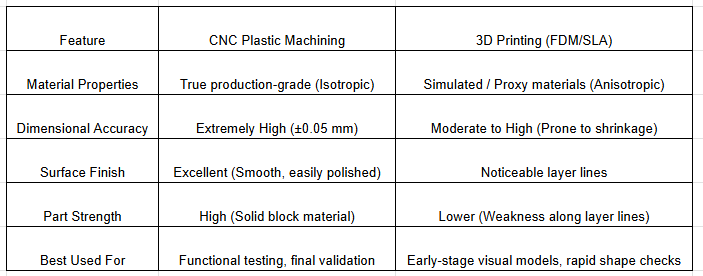
CNC Plastic Machining vs. 3D Printing: A Quick Comparison
To understand when to deploy CNC machining, consider this operational comparison:
Conclusion
Prototype machining is not merely a step in the product development cycle; it is the bridge between digital theory and physical manufacturing. By utilizing CNC plastic machining, design teams can test real-world material properties, achieve unparalleled precision, and secure stakeholder confidence—all while protecting the bottom line from costly injection molding errors.
When your project demands accurate functional testing, CNC plastic machining is the undeniable gold standard.