
Why the Steps in Rapid Prototyping Machining Services Matter for Your Product Launch
In the era of digital manufacturing, there is a common misconception that rapid prototyping is as simple as uploading a 3D CAD file and pressing a "print" or "machine" button. In reality, transforming a digital concept into a flawless physical part is a highly complex engineering workflow.
When B2B buyers search for rapid prototyping machining services, they often focus solely on the final price and lead time. However, the process—the exact sequence of steps a manufacturer takes to produce your part—is what truly determines the success or failure of your prototype.
Skipping or rushing these critical steps leads to out-of-tolerance parts, wasted budgets, and delayed product launches. Here is why every single step in the rapid prototyping machining process matters, and what you should expect from a top-tier manufacturing partner.
1. Design for Manufacturability (DFM) Analysis: The Foundation
Before a single piece of metal or plastic is cut, a rigorous DFM review must take place. This is where engineering theory meets physical reality.
During this step, experienced machinists evaluate your CAD model to identify features that are either impossible, too expensive, or too time-consuming to machine.
Why it matters: Modifying a CAD file takes minutes; modifying a physical machining setup or scrapping ruined material takes days. A proper DFM step identifies sharp internal corners requiring costly EDM, overly deep pockets that cause tool deflection, or unnecessarily tight tolerances, saving you significant time and money.
2. Precision Material Selection and Preparation
A prototype is only as reliable as the material it is made from. Unlike some rapid prototyping methods that use proxy resins, CNC machining utilizes the exact production-grade metals (like Aluminum 6061 or Titanium) and plastics (like POM, ABS, or PEEK) that your final product will use.
Why it matters: Sourcing high-quality, certified raw material blocks prevents internal stresses from warping the part during machining. Proper material preparation ensures that your functional testing yields accurate, real-world data regarding tensile strength, thermal resistance, and durability.
3. Advanced CAM Programming and Toolpath Strategy
Computer-Aided Manufacturing (CAM) programming is the "brain" of the machining process. The programmer dictates exactly how the CNC machine will remove material, selecting the right cutting tools, spindle speeds, and feed rates.
Why it matters: An optimized toolpath strategy prevents tool breakage, manages heat generation (especially critical when machining plastics), and ensures a smooth surface finish. Poor CAM programming results in severe vibration (chatter), melted plastic edges, or dangerous machine collisions.
4. Multi-Axis CNC Machining Execution
This is the physical subtraction of material using advanced 3-axis, 4-axis, or 5-axis CNC milling and turning centers.
Why it matters: Executing the machining phase with state-of-the-art equipment ensures that complex geometries, deep cavities, and intricate undercuts are carved out with extreme precision. Utilizing 5-axis machines allows the part to be cut in a single setup, which drastically reduces alignment errors and ensures perfect concentricity across the prototype.
5. Post-Processing and Surface Finishing
Once the part comes off the CNC machine, it is functional, but it may have visible tool marks. The post-processing step tailors the tactile and visual properties of the prototype to match the final product.
Why it matters: Whether your part requires bead blasting for a uniform matte texture, vapor polishing for optical clarity, or anodizing for corrosion resistance, proper finishing ensures your prototype is ready to be presented to investors or subjected to harsh environmental testing.
6. Rigorous Quality Control (QC) and Metrology
The final step is verifying that the physical prototype matches the digital CAD model perfectly.
Why it matters: A prototype with a $0.1 \text{ mm}$ deviation might look fine to the naked eye, but it will cause a catastrophic failure during assembly. Using Coordinate Measuring Machines (CMM) and laser scanning ensures every dimension, thread, and tolerance is strictly verified before the part is shipped.
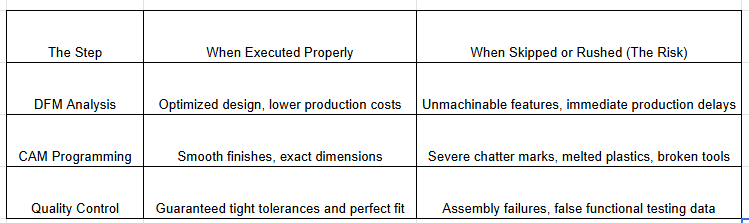
The Cost of Skipping Steps: A Quick Comparison
When evaluating low-cost machine shops against professional engineering partners, consider what happens when steps are ignored:
Trust Your Prototyping Process to AluPrototype
Every step in the rapid prototyping process is a building block for your product's success. Partnering with a manufacturer who respects and perfects this workflow is the ultimate risk-management strategy.
At Shenzhen Alu Rapid Prototype Precision Co., Ltd, we do not cut corners. We follow a strict, highly engineered workflow to transform your digital concepts into flawless physical realities. From our complimentary, in-depth DFM analysis to our high-speed 5-axis CNC machining and rigorous CMM quality control, we ensure every step of your project is executed with absolute precision.
Whether your project requires custom CNC machining, plastic injection molding, sheet metal fabrication, or die casting, our engineering team has the diverse industrial expertise to scale your idea from prototype to mass production.
Experience a manufacturing process where every step matters.Contact AluPrototype Today to submit your CAD files for a free DFM review and an instant quote!