
What is the Vacuum Casting Process in Rapid Prototyping? A Complete Guide
When developing a new plastic product, bridging the gap between a single 3D-printed prototype and high-volume plastic injection molding can be challenging. What if you need 20, 50, or 100 highly detailed, functional parts for market testing, trade shows, or clinical trials?
Investing tens of thousands of dollars in a steel injection mold for such a low quantity is rarely cost-effective. This is where the vacuum casting process becomes the ultimate rapid prototyping solution.
In this comprehensive guide, we will explore what vacuum casting is, how the process works step-by-step, and why it is the industry standard for high-quality, low-volume plastic manufacturing.
What is Vacuum Casting?
Vacuum casting (often referred to as polyurethane casting or silicone mold casting) is a highly versatile rapid prototyping process used to produce small batches of high-fidelity plastic and rubber parts.
It involves creating a soft silicone mold from a "master pattern" and then pouring liquid polyurethane resins into that mold under a strict vacuum environment. The vacuum draws out all trapped air bubbles, ensuring the final cast part is dense, structurally sound, and an exact replica of the original master design.
By utilizing different polyurethane resins, vacuum casting can perfectly simulate the mechanical and thermal properties of production-grade plastics like ABS, Polycarbonate (PC), Nylon, and even flexible elastomers (rubber/TPU).
How Does the Vacuum Casting Process Work? (Step-by-Step)
The beauty of vacuum casting lies in its efficiency and precision. A professional rapid prototyping facility follows these four critical steps to produce flawless cast parts:
Step 1: Creating the Master Pattern
Before a mold can be made, a physical master pattern of the design must be created. This is typically manufactured using high-resolution SLA 3D printing or precision CNC plastic machining. The master pattern is then meticulously hand-sanded, polished, and painted because the silicone mold will capture every microscopic detail—including the surface texture.
Step 2: Making the Silicone Mold
The finished master pattern is suspended inside a casting box. Liquid silicone is poured over the pattern until it is completely submerged. The box is then placed in a curing oven. Once the silicone has hardened, it is carefully cut open, and the master pattern is removed. This leaves behind a perfect, hollow negative cavity—your silicone mold.
Step 3: Mixing and Pouring Under Vacuum
The empty silicone mold is closed and sealed. The chosen two-part polyurethane resin is mixed and poured into the mold inside a specialized vacuum casting machine. The vacuum environment violently pulls all atmospheric air out of the chamber and the liquid resin. This guarantees that no air bubbles are trapped inside the mold's complex cavities, preventing weak spots or surface defects.
Step 4: Curing and Demolding
The mold is placed in a heating oven to accelerate the curing of the polyurethane resin. Once fully cured and solidified, the mold is opened, and the final part is removed. The silicone mold can then be resealed and reused.
Key insight: A single silicone mold typically yields between 15 to 25 high-quality parts before the silicone begins to degrade. For larger orders, multiple silicone molds can be made from the original master pattern.
Key Benefits of Vacuum Casting in Product Development
Why do top engineering teams choose vacuum casting over other rapid prototyping methods?
Low Tooling Costs: Silicone molds cost a fraction of what hard steel or aluminum injection molds cost, saving you thousands of dollars during the prototyping phase.
Exceptional Surface Finishes: Because silicone copies the master pattern exactly, you can cast parts with specific textures (matte, glossy, leather-grain) without needing expensive post-processing.
Material Versatility: You can cast rigid plastics, clear optical lenses, or soft rubber-like overmolds. Color pigments can also be mixed directly into the resin, providing custom-colored parts right out of the mold.
Speed to Market: While cutting an injection mold takes weeks or months, a batch of 50 vacuum-cast parts can often be delivered in just 7 to 10 days.
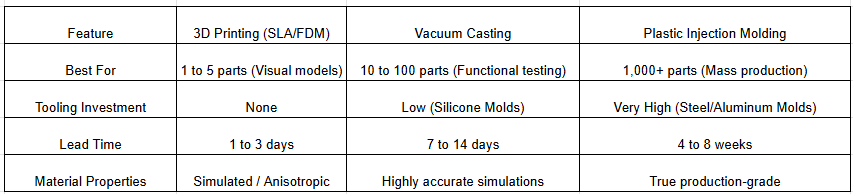
Vacuum Casting vs. Injection Molding vs. 3D Printing
To understand where vacuum casting fits into your product development cycle, review this quick comparison:
Common Applications for Vacuum Cast Prototypes
Because it perfectly mimics the look, feel, and function of injection-molded plastics, vacuum casting is heavily utilized in:
Medical Devices: Creating small batches of biocompatible housings for clinical trials.
Consumer Electronics: Prototyping colored, textured enclosures and clear display lenses.
Automotive Interiors: Producing low-volume dashboard components, knobs, and rubber seals.
Trade Show Models: Creating high-fidelity, "looks-like, works-like" marketing samples to secure investor funding.
Bridge the Gap to Mass Production with AluPrototype
Vacuum casting is the smartest way to validate your product's design and functionality without committing to expensive hard tooling. But achieving flawless cast parts requires master craftsmen who understand material chemistry, precise curing temperatures, and expert finishing techniques.
At Shenzhen Alu Rapid Prototype Precision Co., Ltd, we provide end-to-end rapid prototyping and low-volume manufacturing solutions. Our state-of-the-art vacuum casting services seamlessly bridge the gap between your initial CNC or 3D-printed models and your final injection-molded production run.
Whether you need 20 clear optical lenses or 50 rubber-overmolded tool handles, our engineering team ensures every part meets your exact specifications.
Ready to accelerate your product development?Contact AluPrototype Today to submit your CAD files for a free DFM review and an instant quote on our premium vacuum casting services!