
Efficient Rapid Tooling Methods: Accelerating Your Production Cycle
In the fast-paced world of industrial manufacturing, the "bridge" between initial prototyping and mass production is often the most critical bottleneck. This is where Rapid Tooling (RT) comes into play. By shortening the lead time for mold creation, manufacturers can launch products faster, test market reactions with smaller batches, and lower the financial risk of full-scale production.
At Aluprototype, we specialize in helping businesses navigate these choices. Below are several highly effective rapid tooling methods used in the industry today.
1. Soft Tooling (Aluminum Molds)
Aluminum is the gold standard for rapid tooling. Because aluminum is significantly easier and faster to machine than hardened steel, these molds can be produced in a fraction of the time.
Best For: Low-to-medium volume production (typically 500 to 10,000 units).
Advantages: Excellent thermal conductivity (shortens cycle times), lower manufacturing cost, and sufficient durability for most engineering plastics.
Ideal Application: Functional testing, market pilot runs, and consumer electronics casings.
2. Vacuum Casting (Silicone Molds)
Vacuum casting is a popular method for creating high-quality plastic or rubber parts using a master pattern (usually created via high-precision 3D printing or CNC).
Best For: Small batches (10 to 50 units) and complex, intricate designs.
Advantages: Very low cost compared to hard tooling, excellent surface finish, and the ability to mimic final production materials (e.g., ABS, PP, PC-like resins).
Ideal Application: Pre-production prototypes, marketing samples, and medical device enclosures.
3. Direct Metal Laser Sintering (DMLS/SLM) for Tooling
With advancements in metal 3D printing, we can now "print" core and cavity inserts directly. This is particularly useful for molds with complex cooling channels.
Best For: High-performance parts requiring intricate geometry that cannot be milled.
Advantages: Enables Conformal Cooling—cooling channels that follow the shape of the part, drastically reducing warping and cycle times in the final injection molding process.
Ideal Application: High-precision automotive parts, aerospace components, and molds with irregular cooling needs.
4. Epoxy/Resin-Based Tooling
For very low-volume needs or non-structural parts, epoxy resin molds reinforced with metal fillers can be used as a cost-effective alternative to metal inserts.
Best For: Very low volume (1–10 units) or simple geometry parts.
Advantages: Extremely fast and inexpensive to create.
Ideal Application: Concept validation and simple decorative parts.
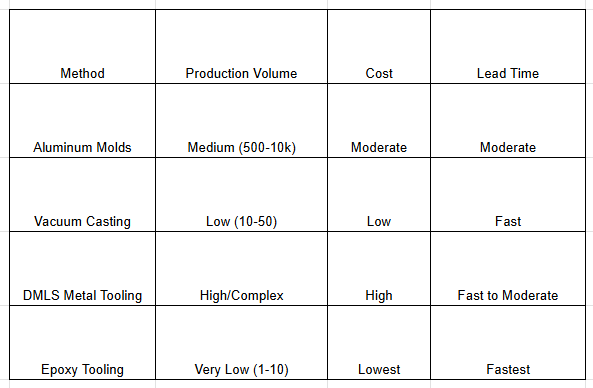
Comparison Table: Which Method Should You Choose?
Why Partner with Aluprototype for Your Tooling Needs?
Selecting the right rapid tooling method depends on your target volume, material requirements, and budget. Atwww.aluprototype.com, we leverage our expertise in CNC machining and rapid manufacturing to provide:
Consultative Engineering: We analyze your CAD files to recommend the most cost-effective tooling approach.
Precision Manufacturing: We maintain tight tolerances to ensure your tools yield high-quality, consistent parts.
Fast Turnaround: We understand that time is money in product development.
Ready to speed up your production process?
Don't let slow tooling hold your innovation back. Reach out to the team at Aluprototype today to discuss your project requirements and receive a fast, competitive quote.